
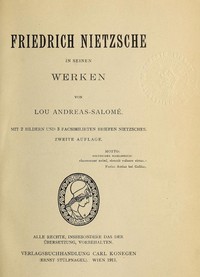
Friedrich Nietzsche in seinen Werken by Lou Andreas-Salomé
Let's be clear: this isn't a novel with a plot. It's a deep, personal study of a philosopher by one of his closest companions. Lou Andreas-Salomé wrote this shortly after her intense friendship with Friedrich Nietzsche ended. She structures it not as a simple life story, but as a journey through his developing mind. She connects his major ideas directly to his personal experiences—his health struggles, his isolation, his yearning for connection.
The Story
The 'story' is the evolution of Nietzsche's thought, seen through Lou's eyes. She starts with the young philologist and follows the thread through his major works, like The Birth of Tragedy and Thus Spoke Zarathustra. But she constantly ties these big ideas back to the man she knew. She shows how his concept of the 'Übermensch' (Overman) grew from his own battle to overcome suffering, and how his rejection of traditional morality was shaped by his feeling of being an outsider. The central drama is internal: it's Nietzsche wrestling with his own genius, his loneliness, and his physical pain to create a philosophy that would shake the world.
Why You Should Read It
You should read this because it makes Nietzsche human. Most secondary sources treat him like a monument. Lou shows us the cracks in the marble. Her writing is sharp, compassionate, and startlingly modern. She doesn't idolize him; she analyzes him with a psychologist's eye (long before she became a famous psychoanalyst!). You get the sense she's trying to truly understand him, not just explain his books. This personal angle is the book's superpower. It adds a layer of emotional truth that pure philosophy texts often miss. You see the cost of his brilliance.
Final Verdict
This is perfect for anyone who finds Nietzsche fascinating but intimidating. It's the best 'backdoor' into his work I've ever found. It's also a must-read for people interested in intellectual history, the art of biography, or the story of remarkable friendships. If you want a detached, academic analysis, look elsewhere. But if you want to feel like you're sitting in a café, listening to a incredibly smart friend tell you the real story behind a legend, this is your book. Just be prepared—it might change how you see philosophy itself.
Legal analysis indicates this work is in the public domain. It is available for public use and education.
Patricia Perez
1 year agoNot bad at all.
Elijah Sanchez
1 year agoThe layout is very easy on the eyes.



Barbara Thompson
9 months agoHaving read this twice, the pacing is just right, keeping you engaged. Definitely a 5-star read.