1

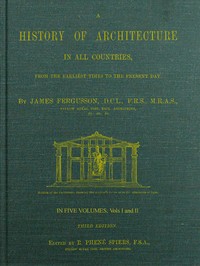
A History of Architecture in all Countries, Volumes 1 and 2, 3rd ed. From the Earliest Times to the Present Day — Edition Insights
(0 User reviews)
74
Project Gutenberg
2017
Not confirmed
Architecture -- History
Readers of public-domain and historical texts
Project Gutenberg digital edition
en
Edition facts
Words
441,003
Reading time
1918 min
Text sections
116
This digital edition of A History of Architecture in all Countries, Volumes 1 and 2, 3rd ed. From the Earliest Times to the Present Day — Edition Insights is described by source-level measurements including 441,003 words, 31 hr 58 min estimated reading time, and 116 detected text sections.
The text analysis averages about 20.2 words per sentence, while the detected sections provide another way to judge how the source is divided.
Project Gutenberg metadata also associates the work with “Architecture -- History,” connecting these edition facts with the source record’s subject description.
Source:
Project Gutenberg record #55870
James Fergusson's sweeping architectural history, here in its third edition edited by R. Phené Spiers, combines a Victorian scholar's confident judgments with detailed technical descriptions, from Egyptian pyramids to Italian Gothic towers, revealing a distinctive narrative voice that blends empirical observation with strong aesthetic opinions.
Read the complete public-domain text at its original source.
Read on Project GutenbergJames Fergusson's A History of Architecture in all Countries opens not with a modest survey but with a firm thesis: architecture is governed by 'true principles' that the author claims to have identified. The third edition, edited by R. Phené Spiers, retains Fergusson's distinctive voice—confident, evaluative, and occasionally dismissive. In the excerpt on Italian Gothic towers, for instance, he declares that the Asinelli and Garisenda towers at Bologna 'possess no more architectural merit than the chimneys of our factories.' Such blunt judgments are characteristic of Fergusson's method: he measures every building against an ideal of structural logic and aesthetic coherence, often finding European examples wanting.
A Critic's Eye: Fergusson's Evaluative Language
Fergusson does not merely describe buildings; he grades them. His vocabulary is consistently judgmental: Italian Gothic towers are 'clumsy,' the Baptistery at Parma 'awkward,' and its columns 'ill-shaped.' He praises the Scaliger tombs at Verona for 'exquisite ornament' but dismisses them as 'hardly important objects of high art.' This evaluative stance is not random—it stems from his conviction that architecture must express structural purpose clearly. When a building conceals its dome behind a 'mere perpendicular wall,' as at Parma, he condemns the design as founded on 'false principles.' Readers should note how Fergusson's language reveals his criteria: words like 'true,' 'false,' 'awkward,' and 'pleasing' recur, turning the history into a sustained argument about what architecture ought to be.
The Editor's Hand: Spiers's Revisions and the Third Edition
The third edition is not a simple reprint. Editor R. Phené Spiers, a Fellow of the Royal Institute of British Architects, added a preface summarizing Fergusson's career and a note on the author's 'peculiar qualifications.' The text itself was updated: the title page boasts '330 Illustrations,' and the transcriber's note records corrections to the printed text. Spiers also oversaw the inclusion of scale bars for illustrations, a practical aid for readers. Yet the editor's presence is discreet; Fergusson's voice remains dominant. The result is a hybrid work—part Victorian polemic, part reference tool—where the original author's strong opinions coexist with later scholarly apparatus. Readers comparing this edition with earlier ones will find shifts in emphasis, particularly in the treatment of non-European architecture, which Fergusson had explored in separate volumes.
Structure and Pace: From Ancient to Modern in Two Volumes
At over 440,000 words, this history moves at a deliberate, encyclopedic pace. The work is divided into two volumes, each covering broad eras: Volume I treats ancient and non-European architecture, Volume II focuses on Christian and modern styles. Within each volume, chapters proceed geographically and chronologically, from Egyptian pyramids to Italian Renaissance. The excerpt on Italian Gothic towers exemplifies Fergusson's method: he begins with a general claim ('There are very few specimens...'), then examines specific buildings, often with measured drawings. The pace is unhurried, allowing for digressions on structural principles and aesthetic judgments. Readers should expect a text that alternates between dense technical description and sweeping generalization, with Fergusson frequently pausing to compare one culture's architecture unfavorably with another's.
Fergusson's history rewards readers who approach it as a document of Victorian intellectual ambition rather than a neutral reference. His strong opinions—on Italian 'false principles' or the superiority of Northern Gothic—are inseparable from his narrative. To read this work is to encounter a mind that saw architecture as a moral and rational art, and judged every building accordingly. The third edition, with its editorial additions and corrections, offers a window into how nineteenth-century architectural history was written, revised, and received.
Rain fell against the window while I turned through Fergusson’s measured chapters, his firm Victorian judgments settling like dust. Somewhere between Egyptian masonry and Italian brickwork, I recalled how another traveler once described similar stones. That afternoon, I set the history aside and opened Letters of an Architect, From France, Italy, and Greece. Volume 1 [of 2] — Inside the Classic, finding quieter, more personal observations beneath the same sky.
There are no reviews for this eBook.
There are no comments for this eBook.
Reader reflection
How will you remember this book?
Save your reaction, strongest insight, and memorable passage.
Your progress
0
/
10
2
Did this book hold your interest?
3
How likely are you to recommend this book?
4
How much effort did this book require?
5
Was the book easy to understand?
6
Which part made the strongest impression?
7
How closely did the book connect with your experience?
8
How useful were the ideas in this book?
9
Which lesson or insight stayed with you?
10