1

Romanesque Art in Southern Manche: Album — Reading Notes
(0 User reviews)
1052
Project Gutenberg
2010
Not confirmed
France -- Description and travel; Churches -- France -- Manche
Readers of public-domain and historical texts
Project Gutenberg digital edition
en
Edition facts
Words
16,763
Reading time
73 min
Text sections
6
The source record for Romanesque Art in Southern Manche: Album — Reading Notes measures this digital text at 16,763 words, 1 hr 13 min estimated reading time, and 6 detected text sections.
The text analysis averages about 14.9 words per sentence, while the detected sections provide another way to judge how the source is divided.
Project Gutenberg metadata also associates the work with “France -- Description and travel,” connecting these edition facts with the source record’s subject description.
Source:
Project Gutenberg record #33249
An album of twelve little-known Romanesque churches in Southern Manche, Normandy, with photos by Alain Dermigny and Claude Rayon. The text focuses on local stone, medieval pilgrimage roads, and the region's historical geography, avoiding standard tourist descriptions.
Read the complete public-domain text at its original source.
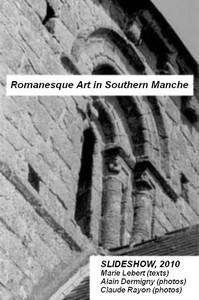
Read on Project GutenbergThis album deliberately avoids the monuments found in standard touristic guides. Instead, it presents twelve Romanesque churches in Southern Manche, built between the 10th and 12th centuries by villagers using local schist and granite. The churches are situated along medieval pilgrimage routes to Mont Saint-Michel, a detail that shapes both their location and their architecture. The author, Marie Lebert, notes that her mother tongue is French, and the text carries a precise, documentary tone, supported by photographs from Alain Dermigny and Claude Rayon.
Local Materials and Construction
The churches are built with stones from the immediate area: schist and granite. This choice is not merely practical but also aesthetic, as the dark, rough textures of these materials give the buildings a distinctive character. The author repeatedly points out the use of small granite quoins in arches and the deep splay of walled-up Romanesque bays. The reliance on local stone ties the architecture to the geology of the region, a theme that runs through the album.
Pilgrimage Routes and Church Placement
The churches are positioned along medieval roads used by pilgrims traveling to Mont Saint-Michel. The text specifies that routes started from Saint-Pair-sur-Mer, Coutances, Saint-Lô, and Caen, converging at Genêts before the final, dangerous crossing of the shores. This network explains why these small churches are scattered across the countryside and coast. The author notes that the region was once richer and more populous, with active fisheries and salines, which supported the construction of these stone buildings.
Historical Layers in Architecture
Many churches show modifications over centuries. For example, in Dragey, the choir bays were enlarged in the 15th century, and a large twin bay with a trefoil arch replaced a rectangular opening in 1860, which itself had replaced a small Romanesque bay in 1790. The text traces these changes without speculation, simply recording what is visible. The church of Genêts, built by Robert Torigni, abbot of Mont Saint-Michel, was consecrated in 1157, but later additions include a 16th-century porch. The album treats each building as a palimpsest of medieval and later interventions.
Photographic Documentation and Detail
The photographs by Alain Dermigny and Claude Rayon are integral to the album. They capture not only the overall structure but also specific features: a walled-up bay, a holy water font supported by an old baptismal font, and a stained glass window commemorating a drowning in 1921. The captions often note the photographer and image number, reinforcing the documentary nature of the work. The text and images together create a record of these churches as they stood in the early 21st century, with attention to both architectural detail and local history.
Readers interested in Romanesque architecture or the history of Normandy will find this album a focused, evidence-based survey. The author's deliberate choice to exclude well-known monuments and instead highlight obscure churches offers a fresh perspective on medieval building practices. The combination of concise text and detailed photographs makes it a useful reference for understanding how local materials, pilgrimage routes, and centuries of use shaped these structures.
Years spent shelving have taught me that some books keep quiet company. The album of Southern Manche’s rough stone chapels, standing patient along forgotten pilgrimage paths, holds that same steadfast hush I find in the Sienese pavement masters, their grey marble etched with patient decades of design. Both speak of hands working slowly, of devotion laid down in local rock, The Pavement Masters of Siena (1369-1562) — Background and Themes echoing that older warmth, stone against stone, a shared whisper.
There are no reviews for this eBook.
There are no comments for this eBook.
Reader reflection
Your personal reading reflection
Build a private reading journal entry for this title.
Your progress
0
/
10
2
How much did you enjoy the reading experience?
3
Is this a title you would suggest to others?
4
How much effort did this book require?
5
How closely did the book connect with your experience?
6
Which aspect of the book did you value most?
7
How valuable was this book for your own interests?
8
How did the pace of the book feel?
9
What did this book teach you most?
10