1

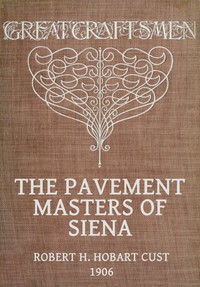
The Pavement Masters of Siena (1369-1562) — Background and Themes
(0 User reviews)
925
Project Gutenberg
2019
Not confirmed
Art -- Italy -- Siena; Duomo di Siena; Pavements, Mosaic
Readers of public-domain and historical texts
Project Gutenberg digital edition
en
Edition facts
Words
38,186
Reading time
167 min
Text sections
17
The Pavement Masters of Siena (1369-1562) — Background and Themes can be approached with a clearer sense of reading commitment from its source measurements: 38,186 words, 2 hr 47 min estimated reading time, and 17 detected text sections.
The text analysis averages about 16.7 words per sentence, while the detected sections provide another way to judge how the source is divided.
Project Gutenberg metadata also associates the work with “Art -- Italy -- Siena,” connecting these edition facts with the source record’s subject description.
Source:
Project Gutenberg record #59168
An editorial note on Cust's 1901 study of the Siena Cathedral pavement, examining how the catalog subject 'Pavements, Mosaic' aligns with the author's focus on graffito technique and biographical records of largely unknown craftsmen.
Read the complete public-domain text at its original source.
Read on Project GutenbergCust opens his preface with a frank admission: he has 'put the cart before the horse' by dwelling on the pavement itself rather than its makers. This structural choice is deliberate—he argues that the pavement is the 'greatest work' through which the masters' names live, since most are 'entirely unknown to the general English reader.' The catalog lists 'Pavements, Mosaic' as a subject, but Cust's text reveals a technique called graffito, not mosaic. The distinction matters: graffito involves scratching through a light surface layer to expose a darker one, a method Cust treats as central to Sienese craftsmanship.
Catalog Subject vs. Actual Technique
The Project Gutenberg record assigns the subject 'Pavements, Mosaic,' yet Cust repeatedly uses the term 'workers in graffito.' The preface to the series lists 'The Pavement Masters of Siena' under 'Workers in Graffito.' This is not a minor discrepancy—graffito and mosaic are fundamentally different techniques. Mosaic sets small pieces of stone or glass into a matrix; graffito is a sgraffito method of layering and scratching. Cust himself notes the pavement is 'unique and historical,' implying its technique is distinctive. Readers expecting a discussion of tesserae will instead find detailed accounts of incised lines and colored cement fills. The catalog subject may mislead, but the text corrects it.
Biographical Fragments and Archival Evidence
Cust draws heavily on Sienese state records and the 'Nuovi Documenti.' The excerpts show entries like '1369. Francesco di Vannuccio' with a note that he 'binds himself to do certain work in the Cathedral.' For Sano di Marco, only a daughter's marriage is recorded. Cust includes such sparse data without embellishment, stating 'Of these men, and their work, nothing is known, but the notices already quoted.' This honesty contrasts with the catalog's implication of a coherent narrative. The book is less a biography of masters than a compilation of archival fragments, with Cust explicitly avoiding criticism because he felt 'unequal to the task.'
The Author's Self-Imposed Limits
Cust states he has 'avoided venturing on criticism' due to limited space and his own perceived inadequacy. He aims instead for 'a clear account of the chain which connects these men together.' The excerpts reveal a method: he presents documents in their original 'quaint language,' declining to translate them because translation would 'lose most of its charm.' This decision preserves the flavor of 14th- and 15th-century Italian but may challenge readers. Cust also marks his theoretical suggestions explicitly as such, a scholarly caution that aligns with the book's 1901 publication date. The result is a work more archival than interpretive, a feature the catalog does not signal.
Readers should approach this book as a documentary record rather than a narrative history. Cust's preface warns that the pavement, not the personalities, is the thread. The catalog's 'Mosaic' label is technically inaccurate; the text itself clarifies the graffito method. Those interested in Sienese art will find a meticulous compilation of contracts, payments, and genealogical notes, but should not expect critical analysis or vivid character sketches. The value lies in the raw archival material Cust assembled, much of it otherwise inaccessible to English readers.
That gray afternoon, tracing the Siena pavement’s forgotten craftsmen, I found myself wondering about the lives behind all such patient work. Their names blurred into quiet anonymity, and somehow my hand drifted to Luigi Lanzi’s older volume, where the same reverence for unnamed hands hums beneath every chapter. The History of Painting in Italy, Vol. 4 (of 6) From the Period of the Revival of the Fine Arts to the End of the Eighteenth Century — Inside the Classic felt less like a history than a shared, murmured regard for what survives.
There are no reviews for this eBook.
There are no comments for this eBook.
Reader reflection
What did you think of this book?
Answer a few questions and save a private reflection on this device.
Your progress
0
/
10
2
How much did you enjoy the reading experience?
3
Would you recommend this book to another reader?
4
How much effort did this book require?
5
Was the book moving at the right speed?
6
Was the book what you thought it would be?
7
Would you read this book again?
8
Would this book work well in a reading group?
9
What did this book teach you most?
10