1

American renaissance; a review of domestic architecture — Reading Notes
(0 User reviews)
1401
Project Gutenberg
2019
Not confirmed
Architecture, Domestic; Architecture -- United States
Readers of public-domain and historical texts
Project Gutenberg digital edition
en
Edition facts
Words
35,855
Reading time
156 min
Text sections
9
Before opening American renaissance; a review of domestic architecture — Reading Notes, the edition data offers a quick orientation: 35,855 words, 2 hr 36 min estimated reading time, and 9 detected text sections.
The text analysis averages about 18.9 words per sentence, while the detected sections provide another way to judge how the source is divided.
Project Gutenberg metadata also associates the work with “Architecture, Domestic,” connecting these edition facts with the source record’s subject description.
Source:
Project Gutenberg record #59862
An architectural review tracing American domestic design from Colonial times to the early 1900s, based on a series of magazine articles. Dow evaluates specific houses, styles, and historical influences, with a critical eye on commercialism and authenticity.
Read the complete public-domain text at its original source.
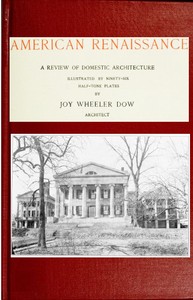
Read on Project GutenbergJoy Wheeler Dow’s American Renaissance originated as a series of papers in the Architects and Builders’ Magazine before being collected into this 1904 volume. Rather than a dry survey, the book offers a personal, opinionated tour through American domestic architecture from the Colonial period to the turn of the twentieth century. Dow, an architect himself, writes with a practitioner’s eye for detail, frequently naming specific houses—such as the Bennett House in New Bedford or the de Zeng House in Middletown—and judging their merits. The text is illustrated with ninety-six half-tone plates, though the excerpts provide only a glimpse of the visual evidence.
A Personal and Critical Stance
Dow does not pretend to neutrality. He openly admires certain buildings and dismisses others, often with a sharp phrase. For instance, he calls the London Terrace houses “sham in comparison” to the Lafayette Place Colonnade, which he considers “the real stuff.” His judgments extend to historical figures: he notes that Washington Irving “spoke and wrote the English language correctly, an uncommon accomplishment in his time,” but adds that Irving was a “dilettante” who “without having anything in particular to say, said it very gracefully.” Such remarks reveal Dow’s criteria—authenticity, craftsmanship, and a certain moral seriousness in design.
Transitional Architecture and Its Defenders
A recurring subject is the Transitional period, which Dow illustrates with houses like the Bennett, Roberts, and de Zeng residences. He admits he would not build a house in that style himself, but if he already owned one, “I should rest content that its architecture could not be improved by any material alteration I could suggest.” This qualified praise reflects his broader view: the best architecture of the Transitional period was admirable but not a model for new work. He also laments the demolition of the Waterbury house, whose “entrancing attic windows screened by the crosses of St. Andrew” he mourns as a loss to the neighborhood.
Commercialism Versus Artistic Integrity
Dow frequently contrasts commercial pressures with genuine artistry. In a chapter titled “Art and Commercialism,” he critiques houses that are “victims of commercialism,” such as the Belmont Houses in New York. He argues that money alone cannot buy architectural quality, as seen in his remark about the Cotton Smith House: “Money will not buy” it. The book’s preface states its aim to trace “the salutary influence upon it of whatever has been good in past building epochs,” suggesting that Dow sees the past as a corrective to the present. His tone is that of a connoisseur addressing fellow architects and informed readers.
Readers should approach American Renaissance as a period document rather than a definitive history. Dow’s strong opinions and specific references—to houses, architects, and even literary figures like Poe—offer a window into early twentieth-century architectural discourse. The book rewards those interested in how architects of the time understood their own tradition, and in the buildings Dow champions or condemns. The illustrations, though not reproduced here, are integral to his argument.
I kept thinking about how that architectural review measures lost authenticity, the way commercial polish hollows out a home’s honest lines. It lingered like a quiet ache. Something in The Venetian Painters of the Renaissance Third Edition — Text and Context feels similar—a reverence for what craft once meant, before fame diluted the light. Strange how two old books can share that same tender sadness.
There are no reviews for this eBook.
There are no comments for this eBook.
Reader reflection
How will you remember this book?
Save your reaction, strongest insight, and memorable passage.
Your progress
0
/
10
2
How much did you enjoy the reading experience?
3
Would you pass this book on to a friend?
4
How much effort did this book require?
5
What did you think about the pace?
6
Did this book create an emotional response?
7
Did you gain anything practical from the text?
8
How personally connected did you feel to the book?
9
What is the main idea you are taking away?
10