1

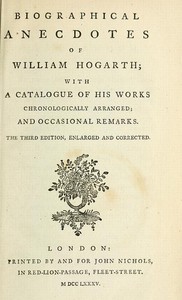
Biographical Anecdotes of William Hogarth, With a Catalogue of His Works — Story, Setting & Ideas
(0 User reviews)
327
Project Gutenberg
2016
Not confirmed
Hogarth, William, 1697-1764
Readers of public-domain and historical texts
Project Gutenberg digital edition
en
Edition facts
Words
148,230
Reading time
645 min
Text sections
21
Before opening Biographical Anecdotes of William Hogarth, With a Catalogue of His Works — Story, Setting & Ideas, the edition data offers a quick orientation: 148,230 words, 10 hr 45 min estimated reading time, and 21 detected text sections.
The text analysis averages about 19.9 words per sentence, while the detected sections provide another way to judge how the source is divided.
Project Gutenberg metadata also associates the work with “Hogarth, William, 1697-1764,” connecting these edition facts with the source record’s subject description.
Source:
Project Gutenberg record #52862
John Nichols's 1785 edition of anecdotes on Hogarth, tracing the book's growth from a pamphlet to a substantial volume, with a chronological catalogue of prints and remarks on their subjects, sources, and reception.
Read the complete public-domain text at its original source.
Read on Project GutenbergJohn Nichols opens his third edition by recounting how a modest note on Hogarth, originally intended for a memoir of his master Mr. Bowyer, expanded into a sixpenny pamphlet, then a three-shilling book, and finally into the present volume. This origin story sets the tone for a work that is as much about the process of collecting and verifying biographical evidence as it is about the artist himself. Nichols frequently cites his informants—such as Dr. Morell, a literary coadjutor to Hogarth—and defends his sources against critics, revealing a meticulous, sometimes combative editorial voice.
A Catalogue Built on Scraps and Disputes
The catalogue of Hogarth's prints, which forms the bulk of the book, is organized chronologically but punctuated by digressions. For instance, under "Taste in High Life" (1742), Nichols explains that the original picture was painted for Miss Edwards, who used Hogarth to satirize her own critics. The print, he notes, was made from a drawing obtained "by connivance of her servants," a detail that underscores the clandestine circulation of Hogarth's designs. Nichols also includes corrections from reviewers, sometimes rejecting their suggestions with sharp remarks—as when he dismisses a critic's reliance on "a consistory of females that ever mumbled their wisdom over a gossip's bowl." These asides reveal the contentious atmosphere in which the catalogue was assembled.
Portraits and the Weight of Testimony
Nichols's entries on portraits, such as that of Captain Thomas Coram, blend description with external evidence. He quotes a satirical poem, the Scandalizade, to characterize Coram's appearance, and notes that Hogarth was an early governor of the Foundling Hospital. The entry for Benjamin Hoadly, bishop of Winchester, is terse—merely listing painter, engraver, and plate owner—while the Coram entry runs longer, including a mezzotint history and a verse. This uneven treatment reflects Nichols's reliance on available documents and correspondents. He does not fabricate details; where information is lacking, the entry remains sparse, a practice that lends credibility to the catalogue as a whole.
The Editor's Voice and the Reader's Role
Throughout the book, Nichols inserts himself as a character: he thanks the Monthly Reviewers for their "extreme candour," corrects errors in earlier editions, and explains how the work grew "by degrees." His footnotes often contain mini-essays, such as a long note on the dancer Desnoyer drawn from The Grub-street Journal. These additions show Nichols using the catalogue as a repository for miscellaneous eighteenth-century lore. Readers should approach the text as a layered document—part biography, part scrapbook—where the editor's judgments and quarrels are as revealing as the facts about Hogarth. The catalogue is not a neutral list but a record of how one collector pieced together an artist's legacy.
Nichols's Biographical Anecdotes rewards readers who enjoy watching an editor at work. The book's value lies not only in its information about Hogarth but in its documentation of the research process itself—the letters, the disputes, the accidental discoveries. To read it is to follow Nichols as he sifts through gossip, corrects proofs, and argues with critics. The result is a portrait of an age's print culture, mediated by a single, persistent compiler.
There’s something touching about how Nichols’s little pamphlet on Hogarth kept growing, edition after edition, as if the man himself couldn’t be contained by a few pages. I felt that same quiet accumulation reading The History of Modern Painting, Volume 2 (of 4) Revised edition continued by the author to the end of the XIX century — Context and Discussion — not a rush, just a slow widening of focus, like watching a familiar street get longer the further you walk it.
There are no reviews for this eBook.
There are no comments for this eBook.
Reader reflection
Your personal reading reflection
Build a private reading journal entry for this title.
Your progress
0
/
10
2
How much did you enjoy the reading experience?
3
Is this a title you would suggest to others?
4
How demanding did the text feel?
5
Did the book meet your expectations?
6
Did you relate to its people, ideas, or situations?
7
How useful were the ideas in this book?
8
Would you read this book again?
9
What is the main idea you are taking away?
10