1

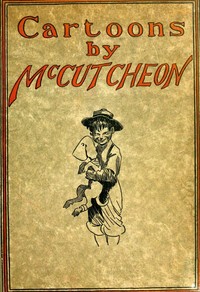
Cartoons by McCutcheon A selection of one hundred drawings — Inside the Classic
(0 User reviews)
1460
Project Gutenberg
2020
Not confirmed
Caricatures and cartoons -- United States; American wit and humor, Pictorial
Readers of public-domain and historical texts
Project Gutenberg digital edition
en
Edition facts
Words
7,100
Reading time
31 min
Text sections
3
The source record for Cartoons by McCutcheon A selection of one hundred drawings — Inside the Classic measures this digital text at 7,100 words, 31 min estimated reading time, and 3 detected text sections.
The text analysis averages about 17.3 words per sentence, while the detected sections provide another way to judge how the source is divided.
Project Gutenberg metadata also associates the work with “Caricatures and cartoons -- United States,” connecting these edition facts with the source record’s subject description.
Source:
Project Gutenberg record #62895
George Ade's introduction and 100 cartoons by John T. McCutcheon, featuring the 'Boy in Springtime' series and satirical takes on politics, coal trusts, and Chicago life, with a gentle humor that avoids savage caricature.
Read the complete public-domain text at its original source.
Read on Project GutenbergGeorge Ade's introduction to this 1903 collection immediately distinguishes McCutcheon's approach: he 'cartoons public men without grossly insulting them' and recognizes that 'political events do not fill the entire horizon of the American people.' This framing sets the tone for the hundred drawings that follow, which range from the recurring 'Boy in Springtime' series to satirical observations of Chicago institutions like the Board of Trade and the Stock Yards.
The excerpts show McCutcheon's humor often emerges from incongruity—a French emissary studying American industrial methods, or Sherlock Holmes deducing a coal trust member by the 'hungry way you looked at my purse.' The cartoons are not merely political; they capture everyday life, from Sunday trolley trips to golf tournaments, reflecting a newspaper artist's broad curiosity.
A Gentle Hand with Public Figures
Ade praises McCutcheon for moving beyond the 'savage caricature' common in earlier newspaper cartoons, where opponents were termed 'reptiles.' Instead, McCutcheon's drawings treat public men with 'considerate treatment,' a quality evident in the excerpts. The coal trust series, for instance, skewers corporate greed without naming individuals: a 'Sympathetic Coal Dealer' laments a customer's suffering while simultaneously delivering coal, and a coal operator admits 'I hate to see all this suffering' but notes 'just see how much money I'm making.' The humor lies in the hypocrisy, not in personal attack.
Even the Sherlock Holmes parody, which targets a coal trust member, focuses on the absurdity of deduction rather than vilifying the man. McCutcheon's satire is systemic, not personal, aligning with Ade's observation that the artist 'recognizes the very large and important fact that political events do not fill the entire horizon.'
Everyday Life Beyond Politics
McCutcheon's range extends well beyond political cartooning. The 'Boy in Springtime' series captures childhood frustrations with a light touch: a boy laments that a lost dog was found 'after the baseball season,' and another grumbles 'Dog gone the luck, anyway' while wearing stiff Sunday clothes. These drawings ground the collection in relatable, non-partisan moments.
Other cartoons document Chicago's social scene: 'The Lake Forest Horse Show,' 'The Women's Golf Tournament,' and 'A Sunday Trolley Trip Along the North Shore.' Ade notes that McCutcheon gives us 'pictures of that every-day life which is our real interest.' The French emissary series, meanwhile, uses a visitor's perspective to comment on American customs—from 'Up-to-Date Architecture' to the 'Enterprising Daily Paper'—blending observation with gentle mockery.
Structure and Repetition of Themes
The collection is organized around recurring subjects, not chronology. The 'Boy in Springtime' appears multiple times, as does the French emissary and the coal trust. This repetition allows McCutcheon to develop running jokes: the coal investigation committee asks absurdly technical questions about hydrogen percentages and Paleozoic versus pre-glacial coal, then submits a report that presumably leads nowhere. The humor accumulates through familiarity.
Other repeated motifs include social happenings in Washington D.C. ('The Tea and Punch Route on Connecticut Avenue') and naval reserves cruises. The excerpts suggest a rhythm of alternating between political satire and lighthearted scenes, a structure that Ade's introduction explicitly praises. Readers can dip into any section, but the full effect emerges from seeing how McCutcheon balances these modes across the hundred drawings.
Voice and Dialogue in the Captions
McCutcheon's captions often carry the humor through colloquial dialogue. The boy's 'Aw, that's easy. I can do lots harder ones than that' captures a child's bravado, while the coal dealer's exaggerated sympathy—'Oh, it breaks my heart'—mocks insincere rhetoric. The Sherlock Holmes parody uses rapid-fire deduction: 'I can tell by your hands that you are in a trust, and I know it was the coal trust by the hungry way you looked at my purse.'
The captions are not mere labels but mini-scenes, often with multiple speech balloons. In 'The Sympathetic Coal Dealer,' the dealer's four lines escalate from apology to outright sale, the contradiction driving the joke. McCutcheon's ear for vernacular—'Dog gone it,' 'Himmel, this monotony is deadly'—gives the drawings a theatrical quality, as if each is a one-act play compressed into a single frame.
Reading this collection sequentially reveals McCutcheon's skill at shifting registers: from a boy's summer adventures to a coal trust investigation to a fox hunt near Chicago. The excerpts offer only a sample, but they suggest a cartoonist more interested in human nature than partisan score-settling. Approach the book as a time capsule of early 1900s American life, where humor arises from everyday contradictions—and where even a coal operator can be funny without being demonized.
Flipping through McCutcheon’s cartoons, I paused on the “Boy in Springtime”—that lazy, hopeful stillness. It reminded me of another old friend, Helen Allingham’s cottages, where the light feels just as unhurried. Both capture a gentler world, observed rather than judged. That quiet fondness lingers, doesn’t it? I found it again in Happy England — Context and Discussion, almost like meeting a shared memory. I set the book down, smiling.
There are no reviews for this eBook.
There are no comments for this eBook.
Reader reflection
How will you remember this book?
Save your reaction, strongest insight, and memorable passage.
Your progress
0
/
10
2
Did this book hold your interest?
3
Is this a title you would suggest to others?
4
How easy was the book to follow?
5
Did the book deliver what you hoped for?
6
How would you rate its originality?
7
How strongly did the book affect you emotionally?
8
Would you like to discuss this book with someone?
9
Which lesson or insight stayed with you?
10