
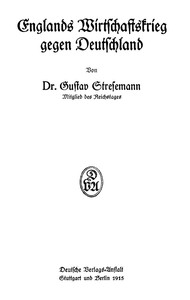
Englands Wirtschaftskrieg gegen Deutschland by Gustav Stresemann
Okay, let's set the scene. The guns of World War I have finally stopped. The Treaty of Versailles is signed. Everyone says the war is over. But according to Gustav Stresemann, Germany's Chancellor and Foreign Minister during the 1920s, the fighting just changed shape. In this book, he lays out a detailed, angry case that England didn't just win the war—it launched a covert economic war to make sure Germany could never recover.
The Story
Stresemann doesn't tell a story with characters in the usual sense. The "characters" are nations, and the plot is a series of economic policies and diplomatic clashes. He walks you through the aftermath of Versailles, but focuses on what happened next: the continued Allied blockade that starved Germany well into 1919, the seizure of German commercial ships and patents, and the crushing burden of reparations. He argues these weren't just penalties for losing, but calculated moves to destroy Germany as an industrial rival. The book is his evidence file, full of trade figures, treaty clauses, and accounts of tense negotiations where he felt Germany was being given no real chance to get back on its feet.
Why You Should Read It
You should read this not for a balanced history lesson, but for a powerful, primary-source dose of perspective. This is not a neutral analysis. It's a political manifesto from a man in the hot seat, trying to rebuild a shattered country while feeling like his opponents were secretly tightening the noose. His frustration and sense of injustice leap off the page. It makes you realize that the famous "German resentment" of the 1920s wasn't some vague mood; for leaders like Stresemann, it was a daily reality based on specific actions and policies. Reading his arguments helps you understand the toxic political soil in which extremism later grew.
Final Verdict
This book is perfect for history buffs who are tired of textbook summaries and want to hear the argument directly from a major player. It's also great for anyone interested in how economic power can be used as a weapon. A word of caution: don't read this as the final truth. Read it as one brilliant, biased, and essential side of the story. Pair it with a book on British post-war policy to see the full picture. Stresemann's account is a gripping, sobering reminder that peace treaties don't always bring peace, and the battles fought in conference rooms can be just as decisive as those fought in trenches.
This book is widely considered to be in the public domain. Distribute this work to help spread literacy.
Thomas Nguyen
2 years agoThe fonts used are very comfortable for long reading sessions.



Amanda Lopez
8 months agoThe index links actually work, which is rare!