1

How to paint permanent pictures — Reading Companion
(0 User reviews)
230
Project Gutenberg
2023
Not confirmed
Colors; Painting -- Technique; Pigments
Readers of public-domain and historical texts
Project Gutenberg digital edition
en
Edition facts
Words
15,792
Reading time
69 min
Text sections
33
This digital edition of How to paint permanent pictures — Reading Companion is described by source-level measurements including 15,792 words, 1 hr 9 min estimated reading time, and 33 detected text sections.
The text analysis averages about 26.8 words per sentence, while the detected sections provide another way to judge how the source is divided.
Project Gutenberg metadata also associates the work with “Colors,” connecting these edition facts with the source record’s subject description.
Source:
Project Gutenberg record #70014
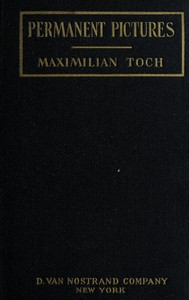
A 1922 technical manual by chemist Maximilian Toch, arguing that artistic permanence depends on material science. The book analyzes pigment stability, varnish behavior, and foundation preparation, warning that many masterpieces are chemically unstable. Toch advocates for mandatory labeling of artists' paints and offers practical tests like the 'needle-proof' method.
Read the complete public-domain text at its original source.
Read on Project GutenbergMaximilian Toch opens How to Paint Permanent Pictures with a blunt observation: many paintings in great galleries are actively decomposing. Fading, darkening, cracking, and peeling are not inevitable—they result from poor material choices. Toch, a professor of industrial chemistry, writes not as a studio artist but as a chemist who believes that permanence is a technical problem with known solutions. The book is a compact manual, first published in 1922, that systematically addresses pigments, oils, varnishes, and supports. Toch’s tone is practical and occasionally indignant; he calls for laws to compel manufacturers to label tubes with permanence ratings and chemical composition. The preface thanks Prof. Carel F. L. DeWild for reviewing the manuscript, signaling the work’s grounding in contemporary chemical knowledge.
The Needle-Proof Test and Drying Realities
Toch introduces a diagnostic method he calls “needle-proof”: a picture is fully dry only when a curved needle cannot puncture its surface. He reports finding paintings years old that still have liquid interiors—a clot of Raw Sienna in a work by Josef Israels remained soft after a decade. This test reveals a central tension in the book: the gap between apparent dryness and actual chemical stability. Toch warns that linseed and poppy oil paints dry from the surface down, forming a wrinkled skin that traps liquid beneath. He advises waiting one to three years before varnishing, especially for heavy impasto or slow-drying pigments. The needle-proof test is not a metaphor; it is a concrete, repeatable procedure that any painter can perform. Toch’s insistence on this test reflects his broader argument that permanence requires patience and scientific understanding, not just artistic intuition.
Varnishes: Solubility as a Virtue
Toch devotes considerable attention to varnishes, ranking them by removability. He prefers mastic and damar because they can be dissolved with turpentine or benzine, allowing safe restoration. He condemns copal oil and amber varnishes for forming hard, insoluble films that force restorers to use strong solvents, risking damage to glazes and delicate tints. The book includes practical notes: mastic may dry unevenly—part glossy, part matte—a defect that can be mitigated with a small addition of lavender oil or linseed oil. Damar behaves differently depending on humidity. These details show Toch’s concern with the unpredictability of materials. He does not simply list varnishes; he evaluates them against the criterion of future reversibility. For Toch, a good varnish is one that can be removed without harming the paint layer beneath—a principle that aligns with modern conservation ethics.
Pigments Under Threat: Sulphur Gases and Restoration
Toch identifies a specific enemy of permanence: sulphur gases in the atmosphere. Pigments such as flake white, chrome yellow, chrome green, Prussian blue, and emerald green are vulnerable to discoloration. He offers a restoration method: wash with weak soap and water, then lightly rub with peroxide of hydrogen. This treatment oxidizes the sulphur-affected compounds and can restore original colors. However, Toch cautions that each case must be handled individually and provides no fixed formula. He also notes that flake white, despite its sensitivity, has superior hiding power—two coats equal four of zinc white. His solution is to seal it with a protective varnish or overlay it with zinc white once dry. The discussion reveals a pragmatic chemist who accepts that some excellent pigments are chemically fragile and that the painter must manage that fragility through technique and timing.
Toch’s book is best read as a period document of applied chemistry, not as a complete painting guide. The excerpts focus on varnishes, drying tests, and pigment vulnerabilities, but the full table of contents shows chapters on tempera, watercolor, painting on metal, and framing. Readers should note that Toch’s recommendations reflect early twentieth-century materials and may not align with current conservation standards. His advocacy for mandatory labeling and his emphasis on reversibility remain relevant. The book rewards those who approach it as a technical treatise rather than a studio handbook.
That gray afternoon, Toch’s insistence on pigments outlasting their painters left me melancholic. I set the manual down, and my fingers wandered to a dusty shelf, pulling out The History of Painting in Italy, Vol. 5 (of 6) From the Period of the Revival of the Fine Arts to the End of the Eighteenth Century — A Closer Reading. It was strange, trading chemistry for biography, yet both whispered the same quiet truth: every canvas is a fragile gamble against time.
There are no reviews for this eBook.
There are no comments for this eBook.
Reader reflection
How did this book work for you?
Your answers remain private and are stored only in this browser.
Your progress
0
/
10
2
Did this book hold your interest?
3
Would you pass this book on to a friend?
4
How easy was the book to follow?
5
Did this book create an emotional response?
6
How valuable was this book for your own interests?
7
Was the book easy to understand?
8
Did you relate to its people, ideas, or situations?
9
In one sentence, what did you learn?
10