1

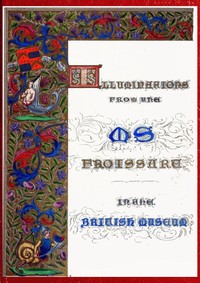
Illuminated illustrations of Froissart; Selected from the ms. in the British museum. — Themes and Context
(0 User reviews)
197
Project Gutenberg
2021
Not confirmed
Illumination of books and manuscripts -- Specimens; Froissart, Jean, 1338?-1410? Chroniques -- Illustrations
Readers of public-domain and historical texts
Project Gutenberg digital edition
en
Edition facts
Words
18,581
Reading time
81 min
Text sections
3
Before opening Illuminated illustrations of Froissart; Selected from the ms. in the British museum. — Themes and Context, the edition data offers a quick orientation: 18,581 words, 1 hr 21 min estimated reading time, and 3 detected text sections.
The text analysis averages about 25.9 words per sentence, while the detected sections provide another way to judge how the source is divided.
Project Gutenberg metadata also associates the work with “Illumination of books and manuscripts -- Specimens,” connecting these edition facts with the source record’s subject description.
Source:
Project Gutenberg record #65908
This 1844 volume reproduces 23 illuminated plates from the British Museum's manuscript of Froissart's Fourth Book, with commentary by Henry Noel Humphreys that describes the miniatures, their borders, and the historical episodes depicted.
Read the complete public-domain text at its original source.
Read on Project GutenbergHenry Noel Humphreys’s 1844 selection of illuminated plates from the British Museum manuscript of Froissart’s Chroniques is confined to the Fourth Book, as the compiler notes in his advertisement. The volume reproduces twenty-three miniatures with accompanying commentary that describes each scene, its border decoration, and the historical episode it illustrates. Humphreys’s text is as much a record of the manuscript’s visual features as it is a summary of Froissart’s narrative, often remarking on the accuracy of costumes or the conventional style of Catholic legends in the illuminations.
A Selection Limited to the Fourth Book
The advertisement makes explicit that the present volume draws only from the two British Museum volumes containing the Fourth Book of Froissart’s chronicles. None of the illustrations refer to the first three books. Humphreys states that a companion selection from the Paris manuscript—which he considers superior in drawing—was planned for publication in January 1844. This limitation means the reader encounters only the events of the later portion of the Hundred Years’ War, such as the vision of Robert l’Ermite and the imprisonment of the Lord de la Rivière, without the earlier battles or campaigns that appear in other manuscript copies.
Humphreys’s Commentary on the Illuminations
Humphreys does not simply reproduce the plates; he offers observations on their execution and historical value. For example, he describes the illumination of King Richard II’s army issuing from a London gate as “peculiarly spirited, both in execution and arrangement,” and notes that the costumes are “made out with sufficient accuracy to render them highly valuable as authorities.” In discussing the vision of Robert l’Ermite, he compares the ship and serpentine waves to “old engravings in some of our early printed Bibles,” tracing the source to Catholic missals. He also points out the recurrence of the De Commines arms in the border, here on “a field of France.”
Froissart’s Prejudices as Recorded in the Text
Humphreys’s commentary occasionally notes Froissart’s own biases. In the section on Ireland, he remarks that the chronicler “shared the common prejudices that existed then, and, unfortunately, exist still against poor Ireland,” quoting Froissart’s description of the Irish as using pointed knives and cutting throats, with some said to devour hearts. Humphreys does not endorse the claim but presents it as evidence of the chronicler’s perspective. This editorial stance—acknowledging but not amplifying the prejudice—gives the reader a critical lens through which to view the historical account.
Readers approaching this volume should treat Humphreys’s descriptions as a guide to the plates rather than a full translation or analysis of Froissart. The commentary is most valuable for its attention to the manuscript’s visual details—borders, heraldry, and compositional conventions—and for its occasional critical remarks on the chronicler’s reliability. The plates themselves, reproduced from the British Museum manuscript, offer a direct view of how Froissart’s history was illustrated in the fifteenth century.
Flipping through these Froissart plates, I remembered sitting in a cold library porch, tracing the gilded borders with a finger, feeling the weight of centuries pressing gently on my lap. It reminded me of the hushed awe I felt with The Cathedrals of Great Britain: Their History and Architecture — Story, Setting & Ideas, where stone seemed to hold the same quiet glow as these painted leaves.
There are no reviews for this eBook.
There are no comments for this eBook.
Reader reflection
Your personal reading reflection
Build a private reading journal entry for this title.
Your progress
0
/
10
2
Did this book hold your interest?
3
Is this a title you would suggest to others?
4
How much effort did this book require?
5
What did you think about the pace?
6
Could you see yourself revisiting this book?
7
How strong was your personal connection to the text?
8
How distinctive were its ideas or approach?
9
In one sentence, what did you learn?
10