
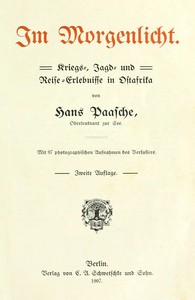
Im Morgenlicht. Kriegs-, Jagd- und Reise-Erlebnisse in Ostafrika by Hans Paasche
Hans Paasche's Im Morgenlicht (In the Morning Light) is a collection of his experiences as a young German officer in East Africa between 1904 and 1906. It's not a single, plotted novel, but a series of vivid episodes from his time there.
The Story
The book reads like a mosaic of colonial life. Paasche describes leading patrols, embarking on long hunting expeditions for ivory, and navigating the complex politics between German settlers, local communities, and the environment. We see the brutal mechanics of empire up close—the demands, the conflicts, the sheer logistical grind. But threaded through these adventures is a subtle shift. Paasche, an enthusiastic hunter, begins to develop a deep respect for the animals and the landscape. His initial, often stereotypical, observations of African people gradually give way to more nuanced descriptions and a growing critique of the colonial project's violence and hypocrisy. The 'story' is the erosion of his own certainty.
Why You Should Read It
What makes this book gripping is its raw honesty. Paasche doesn't write as a later-day saint; he shows us his prejudices and his pride. That's what makes his transformation so powerful. You're inside the head of someone realizing the world he's helping build is wrong. His growing love for the East African wilderness is beautifully described, making the exploitation he witnesses even more jarring. It's a rare, unfiltered look at the cognitive dissonance of colonialism from a participant who couldn't quite ignore his conscience.
Final Verdict
This is a challenging but rewarding read. It's perfect for readers interested in colonial history, travel writing, or moral philosophy, but who want a personal, ground-level view rather than a textbook analysis. Be prepared for dated language and perspectives—that's part of the historical record. But if you can sit with that discomfort, you'll find a profoundly human document about a man wrestling with his duty, his eyes, and his soul. It’s less about grand battles and more about the quiet, unsettling dawn of doubt.
This publication is available for unrestricted use. Access is open to everyone around the world.


Noah Williams
3 months agoI have to admit, the arguments are well-supported by credible references. Exactly what I needed.