1

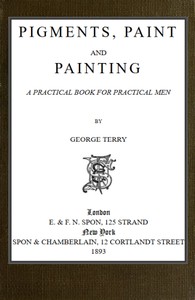
Pigments, Paint and Painting: A practical book for practical men — Inside the Classic
(0 User reviews)
1024
Project Gutenberg
2018
Not confirmed
Paint; Pigments; Painting, Industrial
Readers of public-domain and historical texts
Project Gutenberg digital edition
en
Edition facts
Words
124,432
Reading time
542 min
Text sections
18
Pigments, Paint and Painting: A practical book for practical men — Inside the Classic can be approached with a clearer sense of reading commitment from its source measurements: 124,432 words, 9 hr 2 min estimated reading time, and 18 detected text sections.
The text analysis averages about 23.4 words per sentence, while the detected sections provide another way to judge how the source is divided.
Project Gutenberg metadata also associates the work with “Paint,” connecting these edition facts with the source record’s subject description.
Source:
Project Gutenberg record #56344
George Terry's 1893 handbook for painters combines practical instruction with scientific principles, examining pigments, oils, and adulteration through a critical lens that values material integrity over expediency.
Read the complete public-domain text at its original source.
Read on Project GutenbergGeorge Terry opens his 1893 handbook by contrasting the old apprenticeship model—where 'serving time' sufficed—with the modern painter's need for scientific understanding of materials. The book's structure moves from general colour theory through individual pigments (blacks, blues, whites) to practical mixing and application, each chapter treating a pigment's origin, manufacture, and commercial pitfalls. Terry repeatedly warns against adulteration, as when he notes that 'guaranteed and best white lead is not pure' and details how chalk, barytes, and other fillers are blended in descending grades. This editorial note focuses on how the work's arrangement and recurring attention to material honesty shape its argument.
From Apprenticeship to Analysis
The introduction establishes a structural tension between inherited craft and systematic knowledge. Terry frames the book as a 'guide-book, handy of reference' that supplements both classroom and workshop. This dual purpose governs the chapter sequence: after a preliminary chapter on colour and pigments, the book proceeds pigment by pigment—blacks, blues, browns, reds, whites—each section blending historical manufacture with chemical tests. The white lead chapter, for instance, moves from Dutch stack process to precipitation methods to adulteration practices, mirroring the book's overall arc from traditional to modern. Terry's voice is that of a practical critic, not a neutral encyclopedist.
The Crystal That Cannot Be Ground Away
A recurring image in the white lead discussion is the crystalline structure of precipitated lead. Terry insists that 'once a crystal always a crystal' and that pulverising only reduces crystal size without altering its inability to form a proper varnish with oil. This metaphor—that a material's fundamental nature resists mechanical correction—recurs in his treatment of substitutes: zinc compounds 'lack body,' and most alternatives are mixed with lead-based driers anyway. The image ties material science to commercial ethics: a painter who cannot recognise crystalline white lead will produce inferior paint, regardless of skill.
Movement Between the Workshop and the Market
Terry frequently shifts from the workshop floor to the marketplace, tracking how materials are transformed between manufacture and sale. In the white lead chapter, he follows the pigment from the stack process through grinding with oil (8–15% oil content) to the grading system of 'firsts, seconds, thirds, and fourths.' He notes that dry powdered white lead exists primarily to enable adulteration, since 'if ground in oil the adulterants cannot be properly incorporated.' This movement—from raw material to finished paint to commercial deception—structures many chapters, making the book as much a guide to purchasing as to mixing.
The Painter as Chemist and Critic
Terry's handbook repeatedly asks the painter to act as a material critic. He provides tests for purity—for example, noting that precipitated white lead's crystalline structure can be detected by its behaviour with oil—and warns that even 'guaranteed' grades are not pure. The book's index, which lists pigments and their properties, reinforces this analytical stance. Terry does not simply describe; he evaluates, ranking processes by their honesty and products by their body and covering power. This evaluative thread gives the work a moral dimension: the practical man must also be an informed judge of what he buys and uses.
Readers approaching Pigments, Paint and Painting should treat it not as a fixed recipe book but as a period argument about material integrity. Terry's insistence on chemical knowledge as a defence against adulteration remains relevant to anyone working with historical paint formulations. The book rewards those who read across chapters, comparing how different pigments are handled, and who attend to the commercial contexts Terry weaves into technical descriptions.
There’s something grounding about George Terry’s old handbook—how he cared about materials lasting, not just looking good. It made me think of Happy England, where the same quiet devotion to place and craft lingers. That sense of honoring what’s real, whether pigment or landscape, stays with you long after. Happy England — Context and Discussion felt like that to me. A gentle echo.
There are no reviews for this eBook.
There are no comments for this eBook.
Reader reflection
What did you think of this book?
Answer a few questions and save a private reflection on this device.
Your progress
0
/
10
2
What was your overall reaction to the book?
3
How likely are you to recommend this book?
4
How much effort did this book require?
5
Did the book meet your expectations?
6
Could you apply anything you learned?
7
Did you relate to its people, ideas, or situations?
8
How strongly did the book affect you emotionally?
9
Which lesson or insight stayed with you?
10