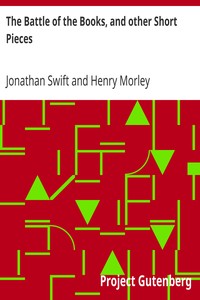
The Battle of the Books, and other Short Pieces by Jonathan Swift
Okay, let's set the scene: It's the late 1600s/early 1700s, and there's a big literary fight brewing. Scholars are arguing about whether ancient Greek and Roman writers were the ultimate geniuses, or if the modern authors of Swift's day had surpassed them. Instead of writing a dry essay, Swift wrote a fantasy.
The Story
In "The Battle of the Books," the library at St. James's Palace becomes a battlefield. The books, led by their authors' spirits, take sides. The Ancients (like Homer and Aristotle) face off against the Moderns (Swift's contemporaries). There's a literal bee and a spider arguing about who builds better, which becomes a metaphor for the whole debate. The battle itself is chaotic and funny, with books using their spines as shields and hurling insults (and maybe a few volumes). It's a short, action-packed allegory that leaves the conflict deliciously unresolved.
Why You Should Read It
Here's the thing: Swift is funny. He's not just some dusty old satirist. His humor is sharp and surprisingly accessible. You can feel his eye-rolling annoyance at intellectual snobbery on both sides. The other short pieces are gems. "A Meditation Upon a Broom-Stick" is a masterpiece of pretending to be profound about the most ordinary object. "Predictions for the Year 1708" shows him pretending to be a psychic, making vague 'prophecies' that are obvious jokes. Reading these is like getting a backstage pass to Swift's mind—he's playful, critical, and never takes himself too seriously.
Final Verdict
This book is perfect for anyone who loves satire with a historical twist. If you've ever enjoyed shows or books that make fun of pretentiousness, Swift was the original. It's also great for readers short on time who want a taste of classic literature without committing to a huge novel. You don't need a literature degree to get the jokes; you just need to have ever witnessed a pointless argument on the internet. Think of it as a short, smart palate cleanser between bigger books—one that proves some human debates are truly eternal.
You are viewing a work that belongs to the global public domain. You are welcome to share this with anyone.
Deborah Martinez
9 months agoRead this on my tablet, looks great.
Patricia Young
1 year agoNot bad at all.
Christopher Sanchez
1 month agoSurprisingly enough, the content flows smoothly from one chapter to the next. I learned so much from this.

Kevin Robinson
1 year agoClear and concise.