1

The Mentor: American Landscape Painters, Vol. 1, Num. 26, Serial No. 26 — Reading Notes
(0 User reviews)
1459
Project Gutenberg
2015
Not confirmed
Landscape painting, American; Landscape painters -- United States
Readers of public-domain and historical texts
Project Gutenberg digital edition
en
Edition facts
Words
8,502
Reading time
37 min
Text sections
7
The Mentor: American Landscape Painters, Vol. 1, Num. 26, Serial No. 26 — Reading Notes can be approached with a clearer sense of reading commitment from its source measurements: 8,502 words, 37 min estimated reading time, and 7 detected text sections.
The text analysis averages about 21.0 words per sentence, while the detected sections provide another way to judge how the source is divided.
Project Gutenberg metadata also associates the work with “Landscape painting, American,” connecting these edition facts with the source record’s subject description.
Source:
Project Gutenberg record #49890
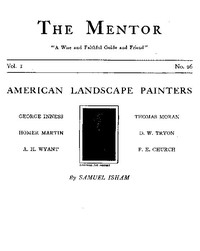
Samuel Isham's 1913 Mentor issue traces American landscape painting from colonial portraits to the Hudson River School and beyond, profiling six painters through their training, techniques, and recurring motifs like the American West and the Adirondacks.
Read the complete public-domain text at its original source.
Read on Project GutenbergSamuel Isham’s 1913 issue of The Mentor opens not with a painter but with a problem: American art began in portraiture, and landscape was a latecomer. The first artist to devote himself entirely to the genre, Thomas Doughty, took up painting at twenty-seven, producing “delicate gray and violet tones” with little encouragement. Isham’s narrative moves swiftly from that tentative start to the emergence of a distinct school, tracing how each painter responded to the American terrain—whether the allegorical grandeur of Thomas Cole, the scientific exactitude of F. E. Church, or the intimate Adirondack scenes of A. H. Wyant.
From Portraiture to the Wild
Isham establishes a clear structural arc: American art began with “grotesque effigies” of colonial figures, then slowly expanded into history, allegory, and genre. Landscape painting did not appear as a dedicated pursuit until 1820, when Thomas Doughty abandoned his leather trade. The author uses this delayed start to frame the landscape school as a deliberate break from European tradition. He notes that Thomas Cole, the “real founder,” was an idealist who painted not for visual pleasure but to “awaken high, moral thoughts.” This philosophical bent, Isham argues, persisted even as later artists moved away from explicit allegory, shifting the interest to “the strangeness or beauty of their subject” rather than personal feeling.
The Painter as Explorer
Several profiles emphasize the artist’s role as an explorer of unknown terrain. Thomas Moran accompanied a government expedition to the West, sketching the Rockies with “a poetic imagination, coupled with an eye trained to note and remember the smallest details.” His paintings of the Grand Canyon and Yellowstone were purchased by the U.S. government for $10,000 each. A. H. Wyant also ventured west, but his expedition ended in disaster: the leader treated him so brutally that he suffered a stroke of paralysis. Wyant then learned to paint with his left hand, producing what Isham calls “more perfect work” than before. These contrasting outcomes—Moran’s success, Wyant’s resilience—underscore the physical and psychological demands of capturing the American landscape.
Recurring Motifs: The Adirondacks and the Ohio Valley
Isham returns repeatedly to specific geographic settings. Wyant made studies of the Ohio Valley, “where no artist of any account had ever painted,” and later turned to the Adirondacks, where his “mystic coloring” hints at an unfulfilled ambition. George Inness, though less tied to a single region, is described as a master who influenced Wyant after the younger man saw his work in Cincinnati. The text also mentions Thomas Cole’s “Course of Empire” and “Voyage of Life” series, which use landscape as a stage for moral narrative. These recurring locations—the Ohio Valley, the Adirondacks, the Rocky Mountains—function as both setting and subject, shaping each painter’s technique and thematic concerns.
Structure and Sequence in the Mentor Format
The issue follows a consistent pattern: each painter receives a biographical sketch that moves from early training to key works and critical reception. Isham often highlights a turning point—Doughty’s career change, Cole’s arrival in New York, Wyant’s stroke—that reorients the artist’s trajectory. The prose is economical, relying on concrete details (Wyant’s apprenticeship to a harness maker, Moran’s family of nine artists) rather than abstract praise. This structure allows readers to compare the painters’ paths: some, like Moran, achieved quick success; others, like Wyant, struggled against physical and financial odds. The result is a compact survey that emphasizes process and perseverance over finished masterpieces.
Isham’s issue is best read as a series of linked portraits rather than a comprehensive history. The brevity of each profile—often just a few paragraphs—means that the reader is invited to notice patterns: the recurrence of engraving as a trade, the importance of European travel, the role of government expeditions. Pay attention to the moments when Isham quotes a painter directly, as in Wyant’s lament, “Had I but five years more in which to paint.” These rare glimpses of the artist’s voice offer the most intimate entry into the ambitions and frustrations that shaped American landscape painting.
That rainy afternoon, Isham’s sketches of the Hudson River School kept pulling me toward their quiet skies and wet earth. I closed the Mentor with a longing for that same stillness, and my hand drifted to a slim volume on the shelf. Treatise on landscape painting in water-colours by David Cox — Story, Setting & Ideas felt like the same rain falling somewhere gentler, teaching patience rather than grandeur.
There are no reviews for this eBook.
There are no comments for this eBook.
Reader reflection
Before you leave, reflect on the book
Use these questions to collect your thoughts before moving on.
Your progress
0
/
10
2
How did the book work for you overall?
3
Would you encourage someone else to read it?
4
What was the reading difficulty like?
5
How useful did the reading feel?
6
How personally connected did you feel to the book?
7
How would you rate its originality?
8
How well did it match your expectations?
9
In one sentence, what did you learn?
10