L
Lilouann Nevelstyn
Guest
- Thread Author
- #1
Building a floating solar power plant goes far beyond assembling components. Anchoring plays a critical role in ensuring the long-term performance and durability of floating solar systems for more than 30 years. So, what does anchoring involve during construction?
In this article, our construction managers will give you their best advice and practices to consider when installing anchoring systems and ensure the floating PV plant reliability.

When installing anchors, accurate positioning is essential. Indeed, staying as close as possible to the design coordinates is mandatory. This guarantees project performance throughout its lifetime. In our processes, we ensure the anchoring layout matches the planned configuration. We then record final GPS positions during and after installation. This validates the final anchoring implementation.
Soil conditions are a key factor in choosing an anchoring solution. Whether it is helical anchors, plate anchors or rock bolt systems, the most suitable technology depends on the technical characteristics of the site and the project requirements. Therefore, choosing the right solution is essential for long-term project performance. Likewise, selecting the installation method suited to local conditions is equally important.
Discover our technologies and methods for reliable anchoring
Safety is another major point across all regions. It includes risk management, PPE and the correct tools and training before starting work. Teams also follow strict safety procedures, including pre-task risk assessments, equipment inspections and site-specific safety briefings before carrying out anchoring operations.
In Japan for instance, maintaining the barge fixed at the designated coordinates during installation is a key element to guarantee accuracy.
In addition, data recording and load testing complete the process. They confirm that each anchor is installed correctly and meets project requirements.
During anchoring installation, the tensioning process is a major step to ensure the safety of the power plant over time. Tensioning consists of applying a controlled load to each mooring line after the anchor has been installed. Once the anchor is driven into the ground at the GPS coordinates defined during the design phase, the installation team gradually pulls the line until it reaches the target tension specified by our engineering teams. This process verifies that the anchor is properly embedded in the seabed or lakebed and capable of withstanding the loads the floating solar plant will experience throughout its operational life.
For example, in Taiwan our construction teams check tension levels using load cells or calibrated instruments. This ensures the applied load remains within the required limits while maintaining a safe working area around the operation.
Similarly, in India, team closely monitor the catenary shape of the mooring line and carry out regular inspections of both the line and the anchors to confirm that tension is applied safely and consistently.
Meanwhile, in Japan, our construction team first provides the design team with the coordinates of the installed anchors. Only then do they make any adjustments. They also pay particular attention to avoid assembly and installation mistakes during tensioning, such as incorrect positioning or improper connections.
Floating solar projects often face unexpected issues related to anchoring, water levels, and timelines. Difficult installations environments often require teams to adapt their methods while keeping projects on schedule.
One of the most common challenges involves fluctuating water levels. In Taiwan, for example, many of our floating solar power plants must be designed to lay on the ground. This is particularly necessary for applications on retention basins, which are designed to hold water during heavy rains but are therefore empty during periods of drought.
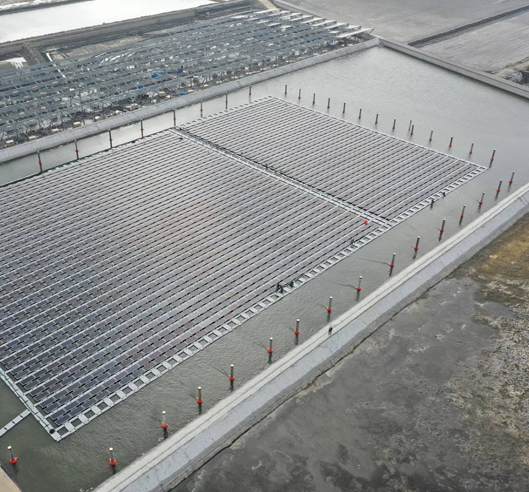
Also, depending on seasonal conditions, water levels can be intentionally lowered to restore storage capacity, creating significant variations that directly affect mooring line tension. Similar challenges happened often on aquaculture ponds such as those in Taixi project, where daily operations often cause water levels to fluctuate. Meanwhile, nearshore projects such as Changbin introduce another dimension to anchoring design, requiring teams to account for marine conditions and continuously changing environmental loads with at 2 tides per day. Under these conditions, the anchor’s design must be carefully calculated and engineered to withstand these fluctuations.
Another example of adapting to site-specific constraints came during the first deployment of Fusio® technology in India. As Mathavan , our construction manager in India, recalls how exceptionally water levels created unexpected challenges during installation. To avoid delays, the team launched the array directly onto water without using a dedicated platform. At the same time, they developed innovative methods for installing underwater cables. For example, they used small buoys to keep the cables afloat while ropes guided the conduits into position. The site itself added another layer of complexity, as crews assembled equipment on slopes reaching 45 degrees, relying on full-body safety equipment and excavators to stabilize heavy components throughout the operation.
Finally, deep water installations bring their own set of challenges. On several projects in the EMEA region, teams had to install concrete blocks anchors in lakes reaching something depths up to 25 meters. Rather than relying on standard equipment, engineers worked closely with specialists to adapt installation tools to the site’s conditions. For plate-anchor installation, teams went one step further, deploying specialized equipment that eliminated the need of divers. Guided pile-driving bars and other dedicated solutions helped ensure accurate placement while improving both efficiency and safety.


The Rumsl Omkareshwar project in India perfectly illustrates how complex site conditions can drive innovation in anchoring design. Covering more than 429 hectares and representing 120 MWp, the project stands out not only for its scale, but also for the site’s technical challenges: highly rocky terrain, water depths exceeding 28 meters, significant water level fluctuations, and wind speeds reaching 140 km/h.

Because the site’s rocky bed made conventional flat or helical anchors unsuitable, our engineering teams developed a dedicated rock bolt anchoring system specifically designed for these geological conditions. Beyond the design itself, the biggest challenge was the anchor installation itself. Indeed, securing the anchors in solid rock required customed installation methods, extending the anchoring works over more than nine months. This project demonstrates that successful floating solar anchoring requires adapting the engineering and installation approach to the site’s unique characteristics.

Located nearshore, Changbin project had to withstand a combination of harsh environmental constraints, including saltwater exposure, tidal cycles, and significant water level fluctuations. For this floating solar project of 192MWp, Ciel & Terre Taiwan developed a dedicated pillar H-Beam anchoring system specifically engineered for these demanding conditions.
Engineers designed the solution to maintain the stability of the floating array. It accommodates the site’s dynamic water movements and ensures long-term structural reliability.
On the Maiwald project in Germany, we used bank mooring system combined with a parabolic line. Located on an active quarry lake, the site had partially inaccessible banks making conventional bank mooring system impractical.To overcome this constraint, our engineering teams designed a parabolic line fixed to the two opposite banks. This allowed the floating solar power plant to be secured along this unique mooring line. In fact, using a conventional anchoring system would have required extremely long lines. On the one hand, this would have posed a risk to the plant’s service life. On the other hand, it would have resulted in exorbitant costs for the project.

By optimizing the mooring geometry through a parabolic line, the project remained technically robust while staying aligned with the client’s business plan and cost objectives.

The Zaltbommel project in the Netherlands was the first to implement our new Bow and Arrow anchoring system. Designed through close collaboration between our R&D and Project teams, this solution was developed to distribute environmental loads more evenly across the floating solar array. By optimizing load distribution, the system helps control array movements while limiting additional stress on the mooring lines.
In a word, for project exposed to high wind, it allows to improve the reliability of the existing anchoring system without installing additional mooring lines. This is thus very convenient solutions for existing projects that need anchoring strength improvement.
Beyond its cost benefits, it also improves the overall stability of the installation by keeping unwanted phenomena under control. Thanks to its ability to balance loads efficiently, the Bow and Arrow anchoring system has proven to be a highly reliable solution. It is particularly suited to areas exposed to extreme wind conditions such as typhoon-prone regions.
On the Alto Rabagao installation we faced two unprecedented factors there:
The main difficulty was to remain precise when calculating the anchors position and of course while installing them.
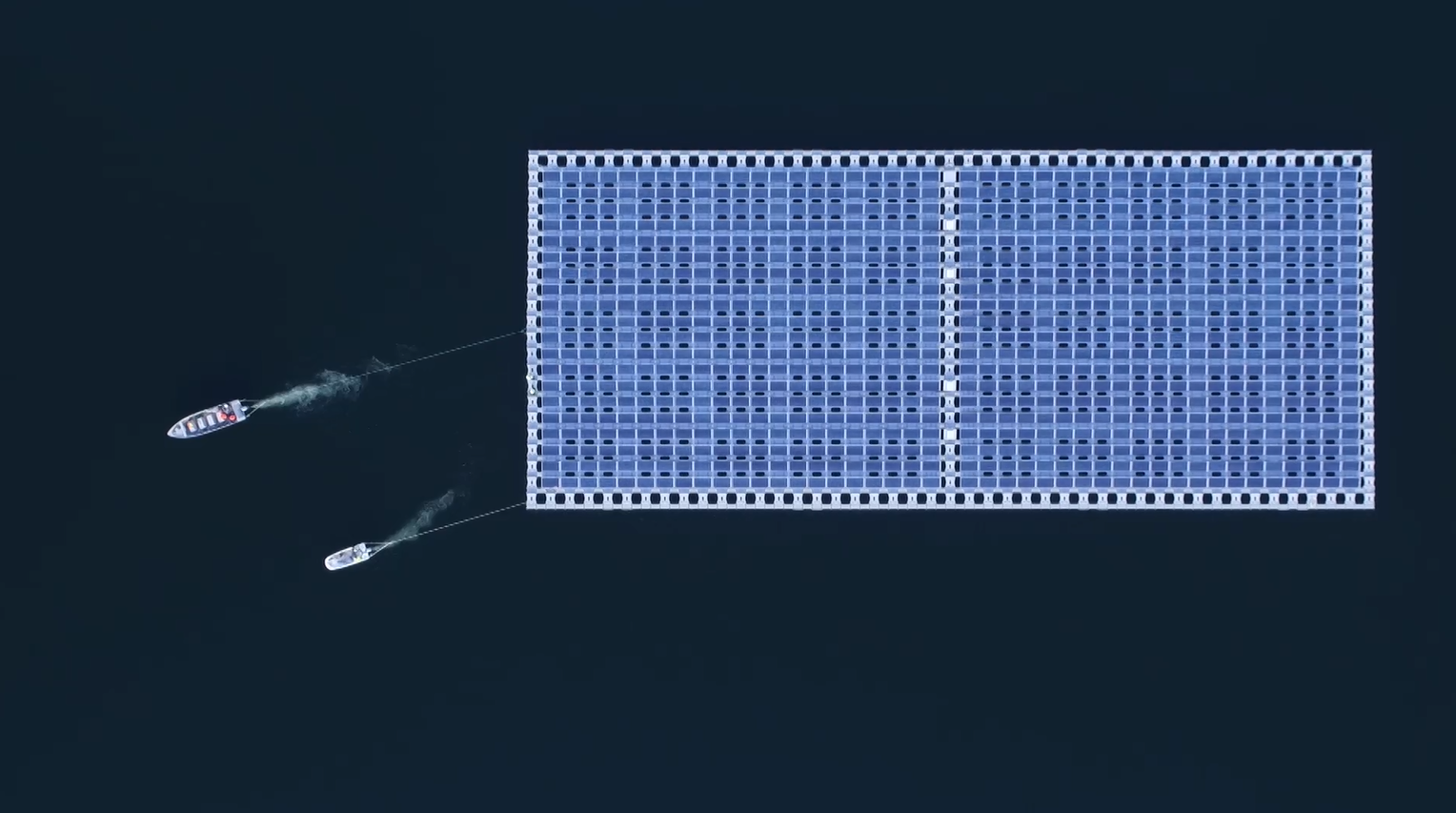
To answer these circumstances, we developed the Ancrelight, our anchor diving floating platform. That tool allowed us to review our capabilities on future projects and broaden our scope of action to new locations and water reservoirs.
Anchoring remains one of the key factors in ensuring the success of a floating solar power plant. Indeed, it forms its foundation. That is why at Ciel & terre we have develop a precise methodology and process to provide reliable anchoring design and solutions to each project entrusted to us. This is especially true during construction phase, where teams must follow precise GPS data to fit with initial FPV design, ensuring the accurate anchor positioning, pay attention to the soil composition to install the right anchoring equipment and assess the reliability of the installation by testing the resistance to the load.
Successful projects also rely on designing the right anchoring approach based on a deep site analysis. Installing anchors is a meticulous process, there are several methods and a wide range of anchor types available. It is therefore necessary to constantly adapt the anchors to the specific requirements of each project. As the case studies presented in this article demonstrate, every site brings its own constraints, but also opportunities to innovate. Whether dealing with rocky terrain, deep reservoirs, tidal environments, or inaccessible shorelines, there is no universal anchoring solution.
By integrating site-specific engineering, proven installation practices, and continuous innovation, floating solar developers can build anchoring systems that not only secure the floating array but also contribute to the long-term reliability, performance, and economic success of the entire power plant.
Do you want to learn more about our anchoring expertise?
Watch our dedicated video about anchoring expertise
By Lilouann, Marketing
The post Best practices to implement anchoring solutions for floating solar projects appeared first on Ciel et Terre.
In this article, our construction managers will give you their best advice and practices to consider when installing anchoring systems and ensure the floating PV plant reliability.
Anchoring Installations: key success factor
Accurate positioning of the anchors on site
When installing anchors, accurate positioning is essential. Indeed, staying as close as possible to the design coordinates is mandatory. This guarantees project performance throughout its lifetime. In our processes, we ensure the anchoring layout matches the planned configuration. We then record final GPS positions during and after installation. This validates the final anchoring implementation.
A good compatibility between the anchor and the soil
Soil conditions are a key factor in choosing an anchoring solution. Whether it is helical anchors, plate anchors or rock bolt systems, the most suitable technology depends on the technical characteristics of the site and the project requirements. Therefore, choosing the right solution is essential for long-term project performance. Likewise, selecting the installation method suited to local conditions is equally important.
Discover our technologies and methods for reliable anchoring
Ensure the safety of the teams and their operations
Safety is another major point across all regions. It includes risk management, PPE and the correct tools and training before starting work. Teams also follow strict safety procedures, including pre-task risk assessments, equipment inspections and site-specific safety briefings before carrying out anchoring operations.
In Japan for instance, maintaining the barge fixed at the designated coordinates during installation is a key element to guarantee accuracy.
In addition, data recording and load testing complete the process. They confirm that each anchor is installed correctly and meets project requirements.
Verify the strength of the anchors against loads
During anchoring installation, the tensioning process is a major step to ensure the safety of the power plant over time. Tensioning consists of applying a controlled load to each mooring line after the anchor has been installed. Once the anchor is driven into the ground at the GPS coordinates defined during the design phase, the installation team gradually pulls the line until it reaches the target tension specified by our engineering teams. This process verifies that the anchor is properly embedded in the seabed or lakebed and capable of withstanding the loads the floating solar plant will experience throughout its operational life.
Processes carried out by our subsidiaries:
For example, in Taiwan our construction teams check tension levels using load cells or calibrated instruments. This ensures the applied load remains within the required limits while maintaining a safe working area around the operation.
Similarly, in India, team closely monitor the catenary shape of the mooring line and carry out regular inspections of both the line and the anchors to confirm that tension is applied safely and consistently.
Meanwhile, in Japan, our construction team first provides the design team with the coordinates of the installed anchors. Only then do they make any adjustments. They also pay particular attention to avoid assembly and installation mistakes during tensioning, such as incorrect positioning or improper connections.
Common anchoring challenges in FPV and how to overcome them
Floating solar projects often face unexpected issues related to anchoring, water levels, and timelines. Difficult installations environments often require teams to adapt their methods while keeping projects on schedule.
One of the most common challenges involves fluctuating water levels. In Taiwan, for example, many of our floating solar power plants must be designed to lay on the ground. This is particularly necessary for applications on retention basins, which are designed to hold water during heavy rains but are therefore empty during periods of drought.
Also, depending on seasonal conditions, water levels can be intentionally lowered to restore storage capacity, creating significant variations that directly affect mooring line tension. Similar challenges happened often on aquaculture ponds such as those in Taixi project, where daily operations often cause water levels to fluctuate. Meanwhile, nearshore projects such as Changbin introduce another dimension to anchoring design, requiring teams to account for marine conditions and continuously changing environmental loads with at 2 tides per day. Under these conditions, the anchor’s design must be carefully calculated and engineered to withstand these fluctuations.
Another example of adapting to site-specific constraints came during the first deployment of Fusio® technology in India. As Mathavan , our construction manager in India, recalls how exceptionally water levels created unexpected challenges during installation. To avoid delays, the team launched the array directly onto water without using a dedicated platform. At the same time, they developed innovative methods for installing underwater cables. For example, they used small buoys to keep the cables afloat while ropes guided the conduits into position. The site itself added another layer of complexity, as crews assembled equipment on slopes reaching 45 degrees, relying on full-body safety equipment and excavators to stabilize heavy components throughout the operation.
Finally, deep water installations bring their own set of challenges. On several projects in the EMEA region, teams had to install concrete blocks anchors in lakes reaching something depths up to 25 meters. Rather than relying on standard equipment, engineers worked closely with specialists to adapt installation tools to the site’s conditions. For plate-anchor installation, teams went one step further, deploying specialized equipment that eliminated the need of divers. Guided pile-driving bars and other dedicated solutions helped ensure accurate placement while improving both efficiency and safety.
WHAT CHALLENGES PROJECTS HAVE TAUGHT US ABOUT ANCHORING DESIGN AND INSTALLATIONS?
Turning a rocky constraint into an anchoring innovation
The Rumsl Omkareshwar project in India perfectly illustrates how complex site conditions can drive innovation in anchoring design. Covering more than 429 hectares and representing 120 MWp, the project stands out not only for its scale, but also for the site’s technical challenges: highly rocky terrain, water depths exceeding 28 meters, significant water level fluctuations, and wind speeds reaching 140 km/h.
Because the site’s rocky bed made conventional flat or helical anchors unsuitable, our engineering teams developed a dedicated rock bolt anchoring system specifically designed for these geological conditions. Beyond the design itself, the biggest challenge was the anchor installation itself. Indeed, securing the anchors in solid rock required customed installation methods, extending the anchoring works over more than nine months. This project demonstrates that successful floating solar anchoring requires adapting the engineering and installation approach to the site’s unique characteristics.
Chanbgin project: Engineering against the tide
Located nearshore, Changbin project had to withstand a combination of harsh environmental constraints, including saltwater exposure, tidal cycles, and significant water level fluctuations. For this floating solar project of 192MWp, Ciel & Terre Taiwan developed a dedicated pillar H-Beam anchoring system specifically engineered for these demanding conditions.
Engineers designed the solution to maintain the stability of the floating array. It accommodates the site’s dynamic water movements and ensures long-term structural reliability.
A parabolic mooring line solution to overcome high depth or long distances.
On the Maiwald project in Germany, we used bank mooring system combined with a parabolic line. Located on an active quarry lake, the site had partially inaccessible banks making conventional bank mooring system impractical.To overcome this constraint, our engineering teams designed a parabolic line fixed to the two opposite banks. This allowed the floating solar power plant to be secured along this unique mooring line. In fact, using a conventional anchoring system would have required extremely long lines. On the one hand, this would have posed a risk to the plant’s service life. On the other hand, it would have resulted in exorbitant costs for the project.
By optimizing the mooring geometry through a parabolic line, the project remained technically robust while staying aligned with the client’s business plan and cost objectives.
Optimising loads distribution with Bow and Arrow anchoring:
The Zaltbommel project in the Netherlands was the first to implement our new Bow and Arrow anchoring system. Designed through close collaboration between our R&D and Project teams, this solution was developed to distribute environmental loads more evenly across the floating solar array. By optimizing load distribution, the system helps control array movements while limiting additional stress on the mooring lines.
In a word, for project exposed to high wind, it allows to improve the reliability of the existing anchoring system without installing additional mooring lines. This is thus very convenient solutions for existing projects that need anchoring strength improvement.
Beyond its cost benefits, it also improves the overall stability of the installation by keeping unwanted phenomena under control. Thanks to its ability to balance loads efficiently, the Bow and Arrow anchoring system has proven to be a highly reliable solution. It is particularly suited to areas exposed to extreme wind conditions such as typhoon-prone regions.
Overcoming extreme depth and water level fluctuations
On the Alto Rabagao installation we faced two unprecedented factors there:
- The first one: an important depth, 80m deep.
- The second one: a very important water variation levels, over 30m per day.
The main difficulty was to remain precise when calculating the anchors position and of course while installing them.
To answer these circumstances, we developed the Ancrelight, our anchor diving floating platform. That tool allowed us to review our capabilities on future projects and broaden our scope of action to new locations and water reservoirs.
Best in class anchoring combines engineering expertise with proven return on experience
Anchoring remains one of the key factors in ensuring the success of a floating solar power plant. Indeed, it forms its foundation. That is why at Ciel & terre we have develop a precise methodology and process to provide reliable anchoring design and solutions to each project entrusted to us. This is especially true during construction phase, where teams must follow precise GPS data to fit with initial FPV design, ensuring the accurate anchor positioning, pay attention to the soil composition to install the right anchoring equipment and assess the reliability of the installation by testing the resistance to the load.
Successful projects also rely on designing the right anchoring approach based on a deep site analysis. Installing anchors is a meticulous process, there are several methods and a wide range of anchor types available. It is therefore necessary to constantly adapt the anchors to the specific requirements of each project. As the case studies presented in this article demonstrate, every site brings its own constraints, but also opportunities to innovate. Whether dealing with rocky terrain, deep reservoirs, tidal environments, or inaccessible shorelines, there is no universal anchoring solution.
By integrating site-specific engineering, proven installation practices, and continuous innovation, floating solar developers can build anchoring systems that not only secure the floating array but also contribute to the long-term reliability, performance, and economic success of the entire power plant.
Do you want to learn more about our anchoring expertise?
Watch our dedicated video about anchoring expertise
By Lilouann, Marketing
The post Best practices to implement anchoring solutions for floating solar projects appeared first on Ciel et Terre.