1

Americans, Drawn by Charles Dana Gibson — Reading Notes
(0 User reviews)
547
Project Gutenberg
2020
Not confirmed
Caricatures and cartoons -- United States; American wit and humor, Pictorial; Drawing, American; United States -- Social life and customs -- 1865-1918 -- Humor -- Pictorial works
Readers of public-domain and historical texts
Project Gutenberg digital edition
en
Edition facts
Words
4,858
Reading time
22 min
Text sections
2
Americans, Drawn by Charles Dana Gibson — Reading Notes can be approached with a clearer sense of reading commitment from its source measurements: 4,858 words, 22 min estimated reading time, and 2 detected text sections.
The text analysis averages about 16.3 words per sentence, while the detected sections provide another way to judge how the source is divided.
Project Gutenberg metadata also associates the work with “Caricatures and cartoons -- United States,” connecting these edition facts with the source record’s subject description.
Source:
Project Gutenberg record #62724
A 1900 collection of eighty-four cartoons by Charles Dana Gibson, satirizing American social types and customs through captioned drawings that blend wit, observation, and a distinctive narrative voice.
Read the complete public-domain text at its original source.
Read on Project GutenbergCharles Dana Gibson’s Americans (1900) is a collection of eighty-four cartoons that dissect turn-of-the-century social rituals with a sharp, economical wit. The captions often do more than label the scene; they create miniature dramatic situations. In one drawing, a manager threatens to break a contract unless the performer “brace[s] up,” and the reply is a deadpan plea: “Don’t say that! I have a child and two husbands to support.” The humor hinges on the absurd arithmetic of the response. Gibson’s line—both in ink and in language—favors compression. A caption such as “Their first quarrel. And they have been engaged about twenty minutes” packs a complete narrative into a single sentence, relying on the reader to fill in the silent, furious body language of the drawing.
The Economy of the Caption
Gibson’s captions often function as punchlines delivered before the visual joke is fully processed. They are not mere labels but compressed dialogues or ironic observations. Consider “A word to the wise. Have a book in case you are bored.” The advice is ostensibly practical, yet the context—a social setting where boredom is anticipated—turns the suggestion into a critique of the gathering itself. The caption does not describe the drawing; it completes it. In “Of course you can tell fortunes with cards. For instance, if the jack of clubs comes between the four and the ten of diamonds, and the following card happens to be the deuce of spades, it means that the next offer of marriage should be accepted,” Gibson parodies the elaborate rules of fortune-telling while satirizing the romantic anxieties of his subjects. The pseudo-specificity of the card sequence mocks the desire for certainty in love. These captions reward rereading: the humor deepens as the reader notices how much is left unsaid.
Recurring Social Types and Their Tensions
Gibson’s cartoons repeatedly feature a set of recognizable figures: the American Girl, the flustered bachelor, the pompous older man, the struggling performer. These types are not static; they interact in ways that reveal social hierarchies and gender dynamics. In “Warning to noblemen. Treat your American wife with kindness,” the caption implies a transatlantic marriage of convenience, with the nobleman warned to behave. The humor is directed at both parties—the wife’s presumed independence and the husband’s potential arrogance. Another cartoon, “To bachelors who wish to avoid competition,” suggests a strategy for evading romantic rivals, but the caption’s brevity leaves the reader to imagine the social maneuvering. Gibson’s types are drawn with affection but also with a satirist’s eye for hypocrisy. The “Venerable Hack” who explains writing as a process of fermentation and skimming off “scum” to sell to a publisher is a self-deprecating portrait of the artist as a cynical professional. These recurring figures create a coherent social world, even if the book presents only isolated scenes.
Pacing and the Rhythm of the Page
The arrangement of cartoons in Americans creates a rhythm of short, punchy gags and longer, more narrative captions. Some pages feature a single large drawing with a terse line; others group smaller panels with rapid-fire exchanges. This variation in density affects how the reader moves through the book. A cartoon like “Melting” (a single word) relies entirely on the visual to convey its meaning, while “A senseless after-dinner custom. So thinks the young man who must listen to her father’s friends during the next hour” builds a scenario through a longer caption that shifts from general complaint to specific, time-bound misery. The reader’s eye is forced to adjust between quick visual jokes and more elaborate setups. Gibson also uses repetition for effect: the phrase “Picturesque America” appears twice, once set “Anywhere in the mountains” and once “Anywhere along the coast,” mocking the formulaic nature of scenic descriptions. This structural play suggests that Gibson was as attentive to the book’s overall pacing as to individual drawings.
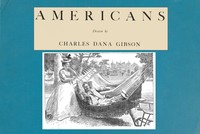
Because the excerpts include only captions and not the drawings themselves, the reader of this digital edition must imagine the visual component. Gibson’s line work—clean, expressive, and economical—was central to his humor. The captions are clues to the drawings’ content, but they are also independent verbal artifacts. Readers may find it useful to consider how the captions would function without the images: many are complete jokes on their own. The book rewards attention to the interplay between text and image, and to the social codes that Gibson both reflects and skewers. Approach each page as a single, carefully timed performance.
Gibson’s cartoons caught a moment of pretense and poise, the way we hold ourselves for others. It lingered because he saw people so plainly, without cruelty. I felt something similar lately in Bell's Cathedrals: The Church of St. Martin, Canterbury An Illustrated Account of its History and Fabric — Themes and Context—a quiet record of stones and habits, telling us who we were by what we left standing.
There are no reviews for this eBook.
There are no comments for this eBook.
Reader reflection
What did you think of this book?
Answer a few questions and save a private reflection on this device.
Your progress
0
/
10
2
What was your overall reaction to the book?
3
How likely are you to recommend this book?
4
Did the language feel accessible?
5
How understandable was the text?
6
Would this book work well in a reading group?
7
Could you see yourself revisiting this book?
8
Which element worked best for you?
9
What did this book teach you most?
10