1

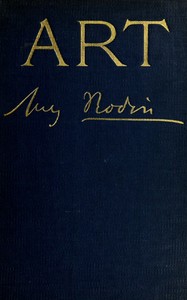
Art — A Reader’s Guide
(0 User reviews)
1816
Project Gutenberg
2019
Not confirmed
Art; Artists; Sculpture; Artists -- France -- Interviews
Readers of public-domain and historical texts
Project Gutenberg digital edition
en
Edition facts
Words
38,473
Reading time
168 min
Text sections
21
The source record for Art — A Reader’s Guide measures this digital text at 38,473 words, 2 hr 48 min estimated reading time, and 21 detected text sections.
The text analysis averages about 19.5 words per sentence, while the detected sections provide another way to judge how the source is divided.
Project Gutenberg metadata also associates the work with “Art,” connecting these edition facts with the source record’s subject description.
Source:
Project Gutenberg record #59799
Rodin's conversations with Paul Gsell, recorded in a series of dialogues, reveal his views on art through specific critiques of fellow artists and reflections on his own methods, structured around visits to his studio and garden.
Read the complete public-domain text at its original source.
Read on Project GutenbergThe book opens not with a treatise but with a walk. Paul Gsell describes approaching Rodin's home at Val-Fleury, a hamlet near Meudon, where three distinct buildings—a Louis XIII pavilion, a rotunda moved from the 1900 exhibition, and an eighteenth-century château façade—sit in an orchard. This physical setting establishes the pattern of the work: movement between spaces frames each conversation. The preface recounts Rodin's initial reluctance, calling artists 'fossils' in an age of engineers, before Gsell persuades him to dictate his ideas. The dialogue form that follows preserves the rhythm of walking, pausing, and looking at specific works.
Walking and Talking: The Structure of the Dialogues
The editorial note by Paul Gsell, who compiled the conversations, reveals that the book's structure mirrors the movement through Rodin's property. Each chapter begins with a description of a location—the garden, the studio, the gallery of casts—before Rodin speaks. This framing device turns the reader into a companion on the walk. Gsell notes that Rodin would stop before a particular sculpture or drawing, and the ensuing discussion would range from technique to the lives of other artists. The transitions between topics are often abrupt, mimicking the interruptions of a real conversation. For instance, a remark about Dalou's ambition leads directly to a reflection on Puvis de Chavannes, as Rodin moves from one bust to another. The reader is never given a systematic lecture; instead, ideas emerge from the physical encounter with objects.
The Bust as Biography: Rodin's Portraits of Contemporaries
Rodin's comments on his busts of Dalou, Puvis de Chavannes, and Jean-Paul Laurens form a core of the book. He describes Dalou's head as that of a man who 'aspired to become the Le Brun of our Republic,' linking the sculptor's ambition to his artistic compromises. Of Puvis de Chavannes, Rodin says the painter 'carried his head high' and imagines him at Pavia 'fighting for his honor.' The physical description—'skull, solid and round'—becomes a moral portrait. Rodin admits that Puvis disliked the bust, calling it 'one of the bitter things of my career.' These passages show Rodin reading character through bone structure and expression, a method he applies to both friends and historical figures. The busts are not mere likenesses but arguments about the relationship between personality and art.
Recurring Images: The Hand, the Fragment, the Unfinished
Throughout the dialogues, Rodin returns to the motif of the hand—both as a sculptural subject and as a symbol of artistic labor. He speaks of pressing the hand of Puvis de Chavannes as if it were 'the hand of Nicolas Poussin,' collapsing time through touch. Elsewhere, he discusses the expressive power of isolated body parts, a practice evident in his own fragmented figures. The book itself reproduces photographs of hands, torsos, and incomplete works. Rodin argues that a fragment can convey more than a finished piece, because it forces the viewer to complete the gesture mentally. This idea recurs when he describes the 'archaic and rude' expression in Laurens's face, or the 'calm glance' of Puvis. The unfinished becomes a deliberate aesthetic choice, not a failure of execution.
The Garden as Gallery: Nature and Artifice in Rodin's World
Gsell's descriptions of the property emphasize the interplay between natural setting and sculptural display. The orchard, the hill, and the buildings are arranged to create 'one of the most enchanting' spots near Paris. Rodin's rotunda, originally built for an exhibition, now houses his works among trees. This blending of indoors and outdoors reflects Rodin's belief that sculpture should be seen in relation to light and landscape. In the conversations, he frequently gestures toward the garden as a source of inspiration, comparing the growth of plants to the emergence of form from marble. The setting is not incidental; it shapes the tempo of the dialogues. Walks are punctuated by stops at specific works, and the natural world provides metaphors for artistic process. The book's structure thus enacts its content: art is not isolated in a museum but embedded in lived space.
Readers approaching this book should expect a series of encounters rather than a unified argument. The dialogues reward attention to the physical details—the tilt of a head, the placement of a studio, the interruption of a thought. Rodin's voice is by turns sardonic, reverent, and blunt, and Gsell's editorial presence ensures that the setting remains visible. To read Art is to walk alongside two men who treat every object as an occasion for reflection.
Sometimes I think of Rodin’s patient hands, shaping clay in the quiet of his garden, and it reminds me of evenings spent rereading The Gate of Appreciation: Studies in the Relation of Art to Life — Reading Companion, where art felt less like a spectacle and more like a slow, private conversation. Both books left me gentler with my own looking.
There are no reviews for this eBook.
There are no comments for this eBook.
Reader reflection
How did this book work for you?
Your answers remain private and are stored only in this browser.
Your progress
0
/
10
2
What was your overall reaction to the book?
3
Is this a title you would suggest to others?
4
How much effort did this book require?
5
How did the reading compare with what you expected?
6
Would you read this book again?
7
Would this book work well in a reading group?
8
Did you relate to its people, ideas, or situations?
9
In one sentence, what did you learn?
10