1

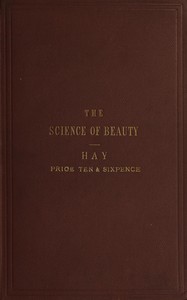
The science of beauty, as developed in nature and applied in art — Text and Context
(0 User reviews)
186
Project Gutenberg
2025
Not confirmed
Aesthetics; Nature (Aesthetics); Proportion (Art)
Readers of public-domain and historical texts
Project Gutenberg digital edition
en
Edition facts
Words
39,819
Reading time
174 min
Text sections
15
The source record for The science of beauty, as developed in nature and applied in art — Text and Context measures this digital text at 39,819 words, 2 hr 54 min estimated reading time, and 15 detected text sections.
The text analysis averages about 30.7 words per sentence, while the detected sections provide another way to judge how the source is divided.
Project Gutenberg metadata also associates the work with “Aesthetics,” connecting these edition facts with the source record’s subject description.
Source:
Project Gutenberg record #75399
D. R. Hay's 1856 treatise argues that beauty in form and color follows a harmonic law based on numerical ratios, drawing on Pythagorean principles and applying them to nature, art, and human anatomy.
Read the complete public-domain text at its original source.
Read on Project GutenbergD. R. Hay opens his 1856 treatise by asserting that beauty in form and colour is governed by a harmonic law rooted in numerical ratios, a principle he traces to the Pythagorean system. Rather than offering a subjective aesthetic, Hay proposes a systematic framework: beauty arises from uniformity and variety combined, a claim he supports with examples from nature, art, and human anatomy. The book is structured as a résumé of his earlier works, aiming to present his theory to a general reader through simple illustration and description.
Hay’s method is notably interdisciplinary, moving from the science of sounds to forms and colours, and culminating in an analysis of the human head and countenance. Throughout, he insists that appreciation of beauty depends not merely on sensory perception but on understanding the æsthetical principles of harmony.
From Pythagorean Ratios to Harmonic Forms
Hay grounds his theory in the Pythagorean system of numerical ratio, claiming that the same proportional relationships that produce musical harmony also govern visual beauty. He writes that his law is “characterised by unity,” yet its applications are “equally characterised by variety.” This dual emphasis on unity and variety recurs throughout the book. In the section on forms, Hay argues that the most beautiful shapes—whether in architecture, the human figure, or organic nature—conform to specific proportional intervals. He provides examples from “all the organic forms of nature, whether animate or inanimate,” though the excerpts only hint at the range of his evidence. The structure of the argument moves deductively: from abstract numerical law to concrete instances in nature and art.
Colour as a Seasonal and Symmetrical Phenomenon
Hay devotes a substantial section to colour, describing it as a phenomenon that “readily excites our admiration” and makes “a vivid impression of the order, variety, and harmonious beauty of the creation.” He traces a seasonal cycle: winter’s “colourless snow” gives way to spring’s “vernal melody,” then to summer’s “full rich hues,” and finally to autumn’s “more vivid and powerful harmonies.” This cyclical movement is not merely descriptive but serves to illustrate his principle that beauty requires both uniformity and variety. He also emphasizes symmetry in colour, noting that in the human countenance “the slightest variety of colour between one and another of the double parts is at once destructive of its symmetrical beauty.” The same uniformity, he observes, appears in the furs, feathers, and shells of animals.
The Role of the Senses and the Limits of Appreciation
Hay distinguishes between mere sensory discrimination and genuine aesthetic understanding. He argues that “an ear for music, or an eye for colour, are, in so far as beauty is concerned, erroneous expressions,” because they refer only to the impression on the senses, not to the “æsthetical principles of harmony.” A person may have a good eye for distinguishing hues, but that does not constitute an appreciation of colour harmony. This distinction is central to Hay’s project: he aims to teach readers not just to see but to understand the underlying law. The excerpts suggest that Hay is writing for an audience already familiar with his earlier works, as he frequently references them and includes “much original matter” on both form and colour.
Movement Between the Organic and the Inorganic
Hay’s analysis moves fluidly between the human figure, animals, plants, and minerals, treating each as a manifestation of the same harmonic law. In the colour section, he notes that “systematic order and uniformity perceptible amidst this endless variety” is a characteristic of beauty “equally prevalent throughout creation.” He cites examples from “the vegetable kingdom,” where leaves, flowers, and fruit of the same plant show uniformity combined with variety, and from minerals, where the same principle holds. This movement from the macroscopic (landscape) to the microscopic (minute objects) reinforces his claim that the law is universal. The book’s structure itself mirrors this progression: from abstract ratios to sounds, forms, human anatomy, and finally colour, each section building on the previous one.
Hay’s book is best approached as a systematic exposition rather than a casual essay. Readers will benefit from following the sequence of sections, as each builds on the numerical and proportional principles established earlier. The frequent references to his earlier works suggest that this volume condenses a larger body of research; those seeking fuller examples may wish to consult those sources. Hay’s insistence on the primacy of harmonic law over subjective taste offers a distinctive lens for examining both natural forms and artistic compositions.
I remember sitting with my father’s old copy of Hay’s treatise, the numbers humming quietly behind petals and faces. It felt like being let in on a secret. Flipping later through The Mentor: Angels in Art, Vol. 1, Num. 40 — Inside the Classic, I had that same hush—as if wings were folded into every measured line, waiting. Both books left me staring out the window, not quite finished thinking.
There are no reviews for this eBook.
There are no comments for this eBook.
Reader reflection
How did this book work for you?
Your answers remain private and are stored only in this browser.
Your progress
0
/
10
2
Did this book hold your interest?
3
Is this a title you would suggest to others?
4
How demanding did the text feel?
5
Did the book offer a fresh perspective?
6
How closely did the book connect with your experience?
7
How clear did the writing feel?
8
Did you gain anything practical from the text?
9
What changed or sharpened your thinking?
10