1

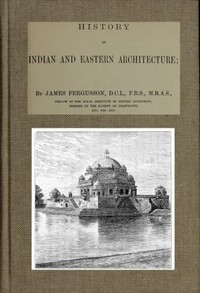
History of Indian and Eastern Architecture — Inside the Classic
(0 User reviews)
649
Project Gutenberg
2020
Not confirmed
Architecture -- India; Architecture, Asian
Readers of public-domain and historical texts
Project Gutenberg digital edition
en
Edition facts
Words
279,180
Reading time
1214 min
Text sections
47
For History of Indian and Eastern Architecture — Inside the Classic, the stored edition analysis reports 279,180 words, 20 hr 14 min estimated reading time, and 47 detected text sections.
The text analysis averages about 21.8 words per sentence, while the detected sections provide another way to judge how the source is divided.
Project Gutenberg metadata also associates the work with “Architecture -- India,” connecting these edition facts with the source record’s subject description.
Source:
Project Gutenberg record #61178
James Fergusson's 1891 survey of Indian and Eastern architecture, drawing on on-site observation and archaeological evidence to argue that the scarcity of ancient Hindu temples in cities like Benares stems more from Brahmanical non-building practices than from Muslim iconoclasm.
Read the complete public-domain text at its original source.
Read on Project GutenbergJames Fergusson, a Victorian architect and archaeologist, opens his History of Indian and Eastern Architecture with a detailed argument about the absence of ancient Hindu temples in Benares. Rather than attributing this solely to Muslim destruction, he contends that the Brahmanical Aryans had 'non-building instincts' and that surviving fragments are Buddhist or Jaina. This claim, supported by references to James Prinsep and Major Kittoe, sets the tone for a work that combines on-site observation with polemical interpretation.
The Benares Debate
Fergusson devotes considerable space to the case of Benares, the 'sacred city, par excellence, of the Hindus.' He notes that no vestige of an ancient Hindu temple exists within its precincts, despite the city's long history. He cites the work of James Prinsep and Major Kittoe, who 'drew and measured everything' yet found nothing ancient. Fergusson dismisses the theory that buildings around the Bakariya Kund are ancient, insisting they were erected by Muslims and that any reused stones came from deserted monasteries. He concludes that the absence of ancient temples is due more to the 'non-building instincts of the Brahmanical Aryans' than to 'iconoclastic bigotry.' This argument is central to his broader thesis about the development of Indian architecture.
Evidence from Gwalior and Other Sites
Fergusson extends his argument to Gwalior, a rock that was 'one of the earliest conquests of the Moslems' and held for five centuries. He points out that Muslims built palaces and mosques there, but does not find evidence of widespread destruction of earlier temples. He also discusses the reuse of Jaina temple columns at Ajmir, Delhi, and Canouge, noting that this was practical rather than wanton. The astylar temples of Siva or Vishnu, he argues, could only serve as quarries. This pattern of evidence—specific sites, named scholars, and material traces—grounds his claims in observable data, even when his conclusions are contentious.
Method and Scope
The work is structured as a comprehensive survey, with 47 text sections and extensive illustrations. Fergusson's method relies on personal observation and comparison of architectural forms across regions. He frequently cites other scholars, such as Prinsep and Kittoe, and engages with competing theories. The catalog subjects—'Architecture -- India' and 'Architecture, Asian'—accurately reflect the content, but the excerpts show that Fergusson's focus is often on religious and historical debates rather than purely formal analysis. Readers should expect a mix of descriptive cataloging and argumentative historiography, shaped by the author's Victorian perspective.
Fergusson's work rewards readers who approach it as a historical document of late-19th-century scholarship. His arguments about temple destruction and Brahmanical practices are specific to his evidence and should be weighed against more recent research. The detailed site descriptions and illustrations remain valuable, but the interpretive framework reflects the author's own biases and the limits of contemporary archaeology.
Fergusson’s careful argument—that Hindu silence in Benares was less demolition than choice—stayed with me, a quiet correction to easy blame. That gentle untangling of built history brought to mind a small volume on North Carolina’s old homes, where similar patience shapes every veranda and brick. Different worlds, yet both whisper that we must read absence gently. A memory of Colonial Homes in North Carolina — Themes and Context felt like a familiar echo.
There are no reviews for this eBook.
There are no comments for this eBook.
Reader reflection
How did this book work for you?
Your answers remain private and are stored only in this browser.
Your progress
0
/
10
2
What was your overall reaction to the book?
3
Would you pass this book on to a friend?
4
What was the reading difficulty like?
5
Which aspect of the book did you value most?
6
Was the book moving at the right speed?
7
Did the book give you something worth debating?
8
How clear did the writing feel?
9
In one sentence, what did you learn?
10