1

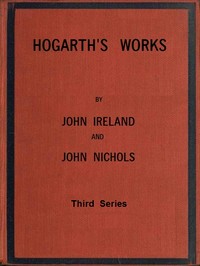
Hogarth's Works, with life and anecdotal descriptions of his pictures. Volume 3 (of 3) — Edition Insights
(0 User reviews)
50
Project Gutenberg
2016
Not confirmed
Hogarth, William, 1697-1764
Readers of public-domain and historical texts
Project Gutenberg digital edition
en
Edition facts
Words
86,112
Reading time
375 min
Text sections
16
Hogarth's Works, with life and anecdotal descriptions of his pictures. Volume 3 (of 3) — Edition Insights can be approached with a clearer sense of reading commitment from its source measurements: 86,112 words, 6 hr 15 min estimated reading time, and 16 detected text sections.
The text analysis averages about 22.5 words per sentence, while the detected sections provide another way to judge how the source is divided.
Project Gutenberg metadata also associates the work with “Hogarth, William, 1697-1764,” connecting these edition facts with the source record’s subject description.
Source:
Project Gutenberg record #52181
This third volume of John Ireland and John Nichols's commentary on Hogarth's engravings includes detailed analyses of the Don Quixote series, comparing Hogarth's designs to Vanderbank's, and discussing composition, character expression, and historical context.
Read the complete public-domain text at its original source.
Read on Project GutenbergThe volume opens with a striking facsimile of Hogarth's autograph 'No Dedication,' a piece of wit in which he declares his work dedicated to 'nobody'—a sly acknowledgment that 'every body is often said to be nobody.' This sets the tone for a collection that treats Hogarth's prints not merely as illustrations but as subjects of critical comparison and anecdotal biography.
John Ireland and John Nichols, the editors, provide running commentary that frequently measures Hogarth against contemporary artists like Vanderbank. Their method is forensic: they examine the 'point of time' chosen, the distribution of light, and the expressiveness of faces. The reader is guided through each plate with a connoisseur's eye, yet the prose remains accessible, grounded in specific observations rather than abstract praise.
The Don Quixote Series: A Comparative Lens
The most sustained sequence in this volume is the analysis of Hogarth's eight Don Quixote plates. Ireland and Nichols do not treat these as isolated works; instead, they repeatedly compare them to the designs by Vanderbank in Jarvis's quarto translation. For Plate V, 'Don Quixote Seizes the Barber's Basin for Mambrino's Helmet,' the editors praise Hogarth's 'spirited' knight and the 'triumphant shout of Sancho,' yet they judge Vanderbank's version superior in its 'chosen point of time' and the 'mixture of cunning and simplicity' in Sancho's face.
This comparative approach reveals the editors' criteria: a successful print must capture the narrative's decisive moment and convey character through posture and expression. They note, for instance, that in Plate VI, 'Don Quixote Releases the Galley Slaves,' Hogarth's figures are 'left-handed' because he neglected to reverse his drawing—a technical flaw they point out without diminishing the overall design. Such frank assessments make the commentary a practical lesson in eighteenth-century print criticism.
Character and Expression in the Plates
Ireland and Nichols consistently foreground the psychological accuracy of Hogarth's figures. In Plate VII, 'The First Interview of the Valorous Knight of La Mancha with the Unfortunate Knight of the Rock,' they admire the 'wild eye of Cardenio, the placid benevolence of Don Quixote, and the shrewdness of the goatherd.' This triangulation of expressions is typical of their method: they read faces as indices of inner states.
Elsewhere, describing a print of a woman swearing her child to a grave citizen, they quote a contemporary description of her as 'broad-faced, flat-pated, saddle-nosed, blind of one eye,' and note that the hostess 'could not have been better marked by the pencil of Teniers.' The owl perched over her head, the cracked walls, and the knight's hard pallet all contribute to a 'variety of wretchedness.' Such passages demonstrate how the editors treat Hogarth's details as a visual language, each element reinforcing the scene's moral or emotional tenor.
Technical Observations: Light, Composition, and Flaws
The editors do not shy from technical critique. In Plate IV, they remark that 'the light is more judiciously distributed' than in Vanderbank's version, and they consider the print 'much superior' for that reason. Yet they also note when Hogarth's execution falls short: in Plate VI, the left-handed figures are a clear oversight, and in Plate VIII, they question whether the chosen moment is the most effective.
These observations are not mere pedantry; they serve to educate the reader in the principles of graphic art. The editors compare the 'tame, feeble, and spiritless' quality of Vanderbank's thieves, who have 'the countenances of apostles,' to Hogarth's more vigorous characterizations. By pointing out what works and what does not, they equip the reader to see prints with a more discerning eye. The volume thus functions as a practical handbook for evaluating narrative art, grounded in the specific examples of Hogarth's oeuvre.
Anecdotal Context and Biographical Framing
Interspersed with the plate descriptions are biographical anecdotes and historical notes. The volume includes Hogarth's manuscript dedication for a projected 'History of the Arts,' a list of plates with page numbers, and references to earlier volumes in the series. The editors, John Ireland and John Nichols, were themselves antiquaries and biographers; their commentary often draws on personal knowledge or contemporary accounts.
For instance, they mention that the 'Dolphin Candlestick' is described on page 123, and they include a facsimile of Hogarth's autograph. These details anchor the prints in a lived context, reminding the reader that Hogarth was not a remote genius but a working artist navigating the London art world. The volume's structure—alternating between plate descriptions and biographical material—mirrors the dual purpose of the work: to document Hogarth's achievement while also preserving the anecdotes that surrounded his life and reputation.
Readers approaching this volume for the first time will find it most rewarding if they have the plates themselves at hand. The commentary assumes familiarity with the images and often refers to specific details—a gesture, a shadow, a misplaced hand—that are invisible without the print. Because the editors frequently compare Hogarth to Vanderbank, it may also be useful to consult the latter's designs, though the volume's arguments stand on their own. Treat the text as a guided tour by two knowledgeable connoisseurs who are unafraid to point out both brilliance and blemish.
The rain kept me indoors with Hogarth’s Don Quixote plates, his wild, lean knight stumbling through ink. I found myself thinking about how a single line can carry a whole character’s stubbornness. Later, drying the windowsill, I picked up something lighter—Americans, Drawn by Charles Dana Gibson — Reading Notes. His pen had a different gentleness, but the same quiet attention to a tilted chin.
There are no reviews for this eBook.
There are no comments for this eBook.
Reader reflection
How did this book work for you?
Your answers remain private and are stored only in this browser.
Your progress
0
/
10
2
How much did you enjoy the reading experience?
3
How likely are you to recommend this book?
4
How demanding did the text feel?
5
Did it raise ideas you would like to talk about?
6
How much did the book move you?
7
How original did the book feel?
8
What did you appreciate most?
9
What is the main idea you are taking away?
10