1

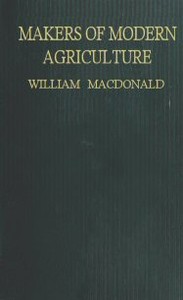
Makers of Modern Agriculture — Background and Themes
(0 User reviews)
2018
Project Gutenberg
2012
Not confirmed
Agriculturists -- Biography; Coke, Thomas William, Earl of Leicester, 1752-1842; McCormick, Cyrus Hall, 1809-1884; Sinclair, John, Sir, 1754-1835; Tull, Jethro, 1674-1741; Young, Arthur, 1741-1820
Readers of public-domain and historical texts
Project Gutenberg digital edition
en
Edition facts
Words
15,886
Reading time
70 min
Text sections
2
Makers of Modern Agriculture — Background and Themes can be approached with a clearer sense of reading commitment from its source measurements: 15,886 words, 1 hr 10 min estimated reading time, and 2 detected text sections.
The text analysis averages about 21.2 words per sentence, while the detected sections provide another way to judge how the source is divided.
Project Gutenberg metadata also associates the work with “Agriculturists -- Biography,” connecting these edition facts with the source record’s subject description.
Source:
Project Gutenberg record #40670
This editorial note examines how William Macdonald's biographical sketches of Jethro Tull, Coke of Norfolk, Arthur Young, and Sir John Sinclair align with the catalog subjects, revealing a focus on individual pioneers rather than broad agricultural history.
Read the complete public-domain text at its original source.
Read on Project GutenbergWilliam Macdonald's Makers of Modern Agriculture (1913) presents biographical sketches of four figures—Jethro Tull, Coke of Norfolk, Arthur Young, and Sir John Sinclair—whose names appear in the catalog subjects. The book's preface frames these men as "pioneers" who discovered "fundamental principles, improved methods, and labour-saving machines," yet the excerpts show Macdonald often dwells on personal anecdotes and character rather than technical innovations. For instance, the account of Sinclair opens with a childhood memory of a man tying shoes on sheep's feet, a detail that reveals more about the author's narrative style than about agricultural history.
Biography Over Technique
The catalog subjects list Agriculturists -- Biography as a primary category, and the excerpts confirm that Macdonald prioritizes life stories over agricultural methods. In the chapter on Arthur Young, the narrative focuses on Young's social connections—correspondents include Washington, Pitt, and Burke—and his personal tragedies, such as the death of his daughter "Bobbin" and his subsequent blindness. Macdonald describes Young's writings as "sparkling prose" and notes that his library contains sixty-six volumes, but he does not explain Young's specific contributions to farming. Similarly, the sketch of Jethro Tull is titled "Founder of the Principles of Dry-Farming," yet the excerpt provides no details on those principles. The reader learns more about Tull's portrait as a frontispiece than about his drill.
The Townsman Farmer Theme
Macdonald's preface introduces a recurring motif: the success of "the Townsman who takes to farming." He argues that this is "contrary to common opinion" and compares it to a farm lad becoming a "Captain of some great commercial enterprise." This theme appears in the biographies, as several subjects were not practical farmers. Arthur Young, for example, is described as an "indigent neighbour" who held a "European levee" to discuss rural economy, while Coke of Norfolk is portrayed as an affluent landowner hosting a "Continental sheep-shearing salon." Macdonald's emphasis on their urban origins or social status aligns with his preface but may surprise readers expecting a focus on agricultural labor. The catalog subjects do not flag this thematic angle, making it a distinctive feature of the book.
Anecdotal Evidence and Missing Machinery
Despite the catalog listing McCormick, Cyrus Hall as a subject, the excerpts do not mention him or his reaper. The provided text covers only Tull, Coke, Young, and Sinclair, suggesting that McCormick may appear in a later chapter not included here. This gap highlights a limitation of the excerpts: they offer no evidence of Macdonald's treatment of mechanical innovation. Instead, the available material emphasizes human-interest stories, such as Sinclair's sheep shoes or Young's religious melancholia. The catalog also includes Tull, Jethro and Young, Arthur, but the excerpts do not detail their agricultural methods. Readers seeking technical descriptions of drills or crop rotation will find only biographical context. The book's structure, with chapters originally published in newspapers, may explain this anecdotal approach.
Readers approaching Makers of Modern Agriculture through its catalog subjects should expect biographical sketches rich in personal detail rather than systematic agricultural history. Macdonald's preface warns that farmers "are not specially fond of reading," and his style aims to engage a general audience. The excerpts suggest that the book's value lies in its portrayal of personalities and social networks, not in technical exposition. For a fuller understanding, one must consult the complete text, especially the missing chapters on McCormick and others.
Leafing through William Macdonald’s sketches of Tull and Sinclair, I kept noticing how each man stood alone, framed by his own quirks and labors. That private focus reminded me of another odd archive—faces caught mid-thought, not histories but instants. There’s a similar quiet intimacy in Americans, Drawn by Charles Dana Gibson — Reading Notes, as if both books simply let individuals breathe on the page, unbothered by the wider tide.
There are no reviews for this eBook.
There are no comments for this eBook.
Reader reflection
What was your reading experience?
Capture what you thought, learned, and would like to remember.
Your progress
0
/
10
2
Did this book hold your interest?
3
Would you pass this book on to a friend?
4
How much effort did this book require?
5
Was the book moving at the right speed?
6
Would you start a conversation about this book?
7
Did the book meet your expectations?
8
How strongly did the book affect you emotionally?
9
In one sentence, what did you learn?
10