1

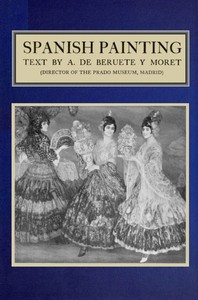
Spanish Painting — Reading Notes
(0 User reviews)
2040
Project Gutenberg
2021
Not confirmed
Painting, Spanish; Painting -- Spain -- History
Readers of public-domain and historical texts
Project Gutenberg digital edition
en
Edition facts
Words
21,409
Reading time
94 min
Text sections
3
Before opening Spanish Painting — Reading Notes, the edition data offers a quick orientation: 21,409 words, 1 hr 34 min estimated reading time, and 3 detected text sections.
The text analysis averages about 32.4 words per sentence, while the detected sections provide another way to judge how the source is divided.
Project Gutenberg metadata also associates the work with “Painting, Spanish,” connecting these edition facts with the source record’s subject description.
Source:
Project Gutenberg record #64796
This editorial note examines the authorial choices in Beruete y Moret's survey of Spanish painting, focusing on his diction, critical voice, and treatment of foreign influence versus national character in the excerpts.
Read the complete public-domain text at its original source.
Read on Project GutenbergBeruete y Moret, director of the Prado Museum, writes with the authority of an insider, yet his prose reveals a tension between admiration for Spanish masters and a critical eye on later periods. In the excerpts, he describes Spanish artists as 'robust, strong and sincere, but without gracefulness, facility of expression or volatility'—a blunt assessment that contrasts with his praise for earlier painters. This note explores how his diction, structural choices, and treatment of foreign influence shape the narrative.
A Curatorial Voice
Beruete y Moret’s language often mirrors the museum catalog: precise, evaluative, and hierarchical. He refers to artists as 'notable,' 'estimable,' or 'lacking character,' assigning them to schools and lineages. For instance, he notes that Cerezo's 'brilliant colour and fine style initiated a tendency' that enriched the Spanish palette, yet he immediately warns that this 'degenerates into a certain poverty at times in the hands of their disciples.' Such phrasing reveals a curatorial impulse to judge and rank, treating artistic movements as organic entities that can flourish or decay.
His diction also betrays a preference for certain qualities: 'vigour,' 'picturesque temperament,' 'fidelity to character.' When discussing the eighteenth century, he shifts to a more critical tone, describing the period as 'a period of misfortune' and attributing the decline to a lack of 'grace and good taste.' This evaluative language, while authoritative, occasionally borders on the prescriptive.
The Problem of Foreign Influence
A recurring concern in the excerpts is the impact of foreign styles on Spanish painting. Beruete y Moret frames this as a 'curious problem of influence,' particularly regarding the 'Spanish decorative painters' and the arrival of artists like Lucas Jordán, Tiépolo, and Mengs. He argues that French art, with its 'marvellous spirit and exquisite culture,' was 'the least adaptable to the Spanish temperament.' The Bourbon monarchy, he writes, attempted to 'transplant Versailles' to Castilian cities still dominated by 'sobriety and asceticism.'
This contrast between native 'robustness' and foreign 'gracefulness' is a structural device: Beruete y Moret uses it to explain why the eighteenth century produced weak national art. He notes that external influences 'were allowed to work freely and with absolute spontaneity,' implying a lack of resistance that led to artistic decline. The language here is almost anthropological, treating national character as a fixed entity that can be corrupted.
Structural Choices and Omissions
The excerpts show a clear chronological structure, moving from the seventeenth century to the eighteenth, but Beruete y Moret’s focus is uneven. He lingers on individual artists like Cerezo and Antolínez, noting their premature deaths, while grouping others into lists: 'Pereda, Collantes and Leonardo are also notable, if lacking the character of their school.' This selective attention creates a hierarchy of importance, with some artists receiving detailed analysis and others mere mention.
Notably, the excerpts contain no discussion of the nineteenth or twentieth centuries, despite the book’s full scope including artists like Sorolla and Zuloaga. The text breaks off after the eighteenth-century section, leaving the reader to wonder how Beruete y Moret treated later movements. His decision to end the excerpted portion with a critique of foreign influence suggests that this theme is central to his overall argument.
Diction and the Rhetoric of Decline
Beruete y Moret’s vocabulary for describing artistic change is often organic and moralistic. He speaks of 'the enrichment of the Spanish palette' and 'the sobriety of which we admire in the masters,' but also of 'degeneration' and 'poverty.' The eighteenth century is characterized by 'misfortune,' and the influence of Mengs is described as having 'much destructive power.' Such language implies a narrative of decline from a golden age, a common trope in art history.
His use of 'we' ('the sobriety of which we admire') creates a shared perspective with the reader, positioning himself as a guide. Yet his judgments are unequivocal: Spanish artists 'still lack' gracefulness. This blend of admiration and critique gives the prose a distinctive tension, as Beruete y Moret balances his role as a national curator with his critical eye.
Beruete y Moret’s editorial choices—his evaluative diction, his focus on foreign influence, and his structural emphasis on decline—reveal a writer deeply invested in defining Spanish artistic identity. Readers should note that these excerpts represent only a portion of the book; the full text includes later chapters on modern painters that may complicate his narrative. Approach his judgments as those of a contemporary critic, not an impartial historian.
That rainy afternoon, I kept returning to Beruete’s quiet insistence on the Spanish soul behind the brushwork, the way he read national character between the lines of foreign technique. It made me think of Gibson’s drawings—not paintings, but faces caught mid-gesture, equally sure of their own world. I found myself reaching for Americans, Drawn by Charles Dana Gibson — Reading Notes almost without deciding to, and the rain kept falling outside, unhurried.
There are no reviews for this eBook.
There are no comments for this eBook.
Reader reflection
How did this book work for you?
Your answers remain private and are stored only in this browser.
Your progress
0
/
10
2
Did this book hold your interest?
3
Would you pass this book on to a friend?
4
How easy was the book to follow?
5
Did the book meet your expectations?
6
How much did the book move you?
7
Would you like to discuss this book with someone?
8
Do you expect to return to this book?
9
What changed or sharpened your thinking?
10