1

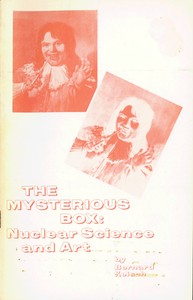
The Mysterious Box: Nuclear Science and Art — Background and Themes
(0 User reviews)
1157
Project Gutenberg
2021
Not confirmed
Painting -- Radiography -- Juvenile literature
Readers of public-domain and historical texts
Project Gutenberg digital edition
en
Edition facts
Words
11,754
Reading time
52 min
Text sections
2
The Mysterious Box: Nuclear Science and Art — Background and Themes can be approached with a clearer sense of reading commitment from its source measurements: 11,754 words, 52 min estimated reading time, and 2 detected text sections.
The text analysis averages about 18.4 words per sentence, while the detected sections provide another way to judge how the source is divided.
Project Gutenberg metadata also associates the work with “Painting -- Radiography -- Juvenile literature,” connecting these edition facts with the source record’s subject description.
Source:
Project Gutenberg record #66082
Bernard Keisch's 1970 booklet blends a fictional beach discovery with real nuclear chemistry, using dialogue and lab scenes to explain how gamma-ray spectrometry and neutron activation analysis authenticate paintings.
Read the complete public-domain text at its original source.
Read on Project GutenbergThe booklet opens with three boys digging a mysterious wooden case from a New Jersey beach, a setup that quickly gives way to a father-led tutorial on nuclear science. The narrative alternates between the boys' summer adventure and detailed explanations of gamma-ray spectrometry, neutron activation analysis, and lead-white dating. Keisch, a nuclear chemist, uses the fictional frame to introduce real forensic techniques, including the measurement of polonium-210 and radium-226 to expose forgeries. The text is brisk, with technical passages punctuated by the boys' questions and the father's patient answers.
A Fictional Frame for Real Science
The story begins with Martin, Harley, and Bill finding a heavy wooden case on the beach. Martin, who has just read Treasure Island, imagines pirate gold, but the box contains paintings and a Geiger counter. This fictional setup is a deliberate pedagogical device: the boys' curiosity drives the exposition. Keisch uses their dialogue to introduce scientific concepts naturally—when the father explains radioactivity, he speaks in complete, clear sentences, as when he says, “The height of each gamma-ray peak tells us how much of that element is present.” The narrative voice is consistently instructive, with the father acting as a surrogate for the author. The boys' ages (eight, nearly ten, and twelve) suggest a target audience of middle-grade readers, but the science is presented without condescension.
Voice and Pacing: From Beach to Laboratory
The prose shifts between two distinct registers. The opening beach scene uses short, action-driven sentences: “Suddenly Martin let out a yell as his toe hit something hard.” Once the family visits the nuclear laboratory, the pace slows for detailed descriptions of equipment. The gamma-ray spectrometer is introduced with a step-by-step account: samples placed inside a lead-brick shield, a lithium-drifted germanium detector, a pulse-height analyzer that sorts electrical impulses. Keisch includes a diagram caption that reads like a textbook: “The location (energy) of each peak indicates what is present and the height indicates how much!” The dialogue in the lab is expository, with the chemist explaining the process while the boys observe. This alternation between narrative and instruction creates a rhythm that mirrors the scientific method—observation, hypothesis, verification.
Recurring Details and the Limits of the Excerpt
Two recurring elements anchor the text: the mysterious box itself and the repeated mention of specific artists. The box is described as “heavy, well built, tightly sealed, and had foreign words written on it,” a detail that echoes the puzzle of art authentication. The paintings inside are attributed to Frans Hals, Alfred Sisley, and Aelbert Cuyp, but the excerpts do not reveal whether all are genuine. The father notes that activation analysis “hasn’t been fully developed yet,” leaving the outcome unresolved. The excerpts also include a section titled “Other New Tools for Art Authentication,” which is cut off, so the full range of methods is unknown. The text is careful to distinguish between established techniques (lead-white dating) and experimental ones, a restraint that keeps the science honest.
Readers should approach this booklet as a hybrid: part instructional manual, part mystery story. The incomplete excerpts leave several paintings unauthenticated, and the promised “other new tools” are only hinted at. The value lies in the clear, step-by-step explanations of nuclear chemistry applied to art, not in the resolution of the plot. For those interested in the intersection of science and art history, this is a concise primer from a period when such techniques were still emerging.
That rainy afternoon, Keisch’s dialogue made authentication feel like quiet detective work—fingertips reading a canvas’s hidden chemistry. It reminded me how many signatures we overlook. Later, idly, I found myself thinking of the women painters absent from most catalogs, and picked up the Women Painters of the World From the Time of Caterina Vigri, 1413-1463, to Rosa Bonheur and the Present Day — Key Ideas to Explore, seeking their quieter truths.
There are no reviews for this eBook.
There are no comments for this eBook.
Reader reflection
How will you remember this book?
Save your reaction, strongest insight, and memorable passage.
Your progress
0
/
10
2
Was reading this book enjoyable?
3
Would you encourage someone else to read it?
4
How demanding did the text feel?
5
Did anything about the book feel genuinely new?
6
Is this a title worth rereading?
7
Did any part of the book feel personally relevant?
8
Could you apply anything you learned?
9
What changed or sharpened your thinking?
10