
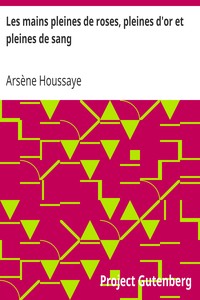
Les mains pleines de roses, pleines d'or et pleines de sang by Arsène Houssaye
Arsène Houssaye wasn't just a writer; he was a social butterfly who flitted through the most exciting circles of 1800s Paris. In this book, he uses his own life as a lens to look at an entire era. It's part memoir, part history, and part collection of vivid character sketches. He takes us from the smoky cafes where poets argued about art, to the lavish salons of famous courtesans, to the chaotic barricades of the 1848 revolutions. The 'story' is really the story of Paris itself—a city of impossible beauty and brutal reality, where a hand could just as easily hold a rose, a bag of gold, or a weapon.
The Story
There's no single plot. Instead, Houssaye builds a mosaic of moments. One chapter might be a funny, intimate portrait of the painter Delacroix. The next could be a heartbreaking account of a young actress's rise and fall. He shows us the hunger of young artists, the calculated glamour of the demimonde, and the sudden, shocking violence of political uprising. The thread connecting it all is transformation. We watch people and a city constantly remaking themselves, for better or worse. The 'hands' in the title are a powerful symbol: they create art, they grasp for wealth, and they fight for change. Often, they do all three.
Why You Should Read It
I loved this book because it has no filters. Houssaye doesn't put historical figures on a pedestal. He shows us their genius, but also their vanity, their affairs, and their desperation. It makes the past feel immediate and relatable. His writing is sharp, witty, and often surprisingly tender. You get the sense he loved these people and this city, flaws and all. The major theme that stuck with me is the price of passion. Whether it's passion for art, for love, for money, or for a new world, Houssaye shows how it can uplift and destroy in equal measure. It's a deeply human look at ambition.
Final Verdict
This is a perfect book for anyone who finds history books too stiff. If you enjoy immersive nonfiction like Dead Wake or character-driven historical fiction, you'll feel right at home. It's especially great for lovers of Paris, art history, or just fascinating real-life stories. Be warned: it's not a linear, easy read. It's a book to savor in pieces, like rich chocolate. You come away feeling like you've just had a long, fascinating conversation with a forgotten friend who knew everyone worth knowing. A truly unique glimpse into the heart of a revolutionary age.
You are viewing a work that belongs to the global public domain. Knowledge should be free and accessible.
Betty Walker
4 months agoEnjoyed every page.




Betty Robinson
1 year agoFive stars!