
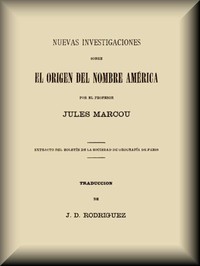
Nuevas investigaciones sobre el origen del nombre América by Jules Marcou
Let's be honest, most of us never think twice about where the name 'America' came from. It's just a fact, like the sky being blue. Jules Marcou's book grabs that simple fact and turns it into a compelling investigation.
The Story
Marcou doesn't just retell the standard story of Amerigo Vespucci. Instead, he acts as a historical detective. He gathers evidence from sources many had overlooked: ancient maps, the records of early explorers, and linguistic patterns. His central argument is that the name 'America' might not be a brand-new invention to honor Vespucci. He points to a district in Nicaragua called 'Amerrique' that was known to both indigenous people and early Spanish explorers. Marcou suggests that this geographical name, carried back to Europe by sailors and maybe even connected to Vespucci's own travels, is the true source. The book is his case file, laying out each piece of this puzzle and asking us to reconsider a history we thought was settled.
Why You Should Read It
What I love most is the feeling of watching a sharp mind at work. Marcou isn't a stuffy historian writing from an ivory tower. You can feel his passion and his frustration with the accepted narrative. Reading it, you get swept up in the 'what if.' It makes you look at history not as a list of dates, but as a story that's still being argued about. It’s a powerful reminder that even the most basic truths we learn can have messy, disputed origins. The thrill is in the chase, not just the conclusion.
Final Verdict
This book is perfect for curious minds who enjoy off-the-beaten-path history, armchair detectives, and anyone who likes seeing established myths get a good shake. It's short, focused, and packed with ideas that will make you see a map differently. If you prefer straightforward, settled history, this might frustrate you. But if you love a good intellectual debate and wondering about the roads not taken in our history books, Marcou's investigation is a captivating and quick read.
No rights are reserved for this publication. Share knowledge freely with the world.
Melissa Garcia
6 months agoAs someone who reads a lot, the content flows smoothly from one chapter to the next. Absolutely essential reading.
Joshua Johnson
1 year agoCitation worthy content.


Steven Davis
11 months agoAfter finishing this book, the depth of research presented here is truly commendable. I couldn't put it down.